


Strategic IT Support for Accountants: A Professional Reference for 2026
- Simon Raine
- 21 hours ago
- 12 min read
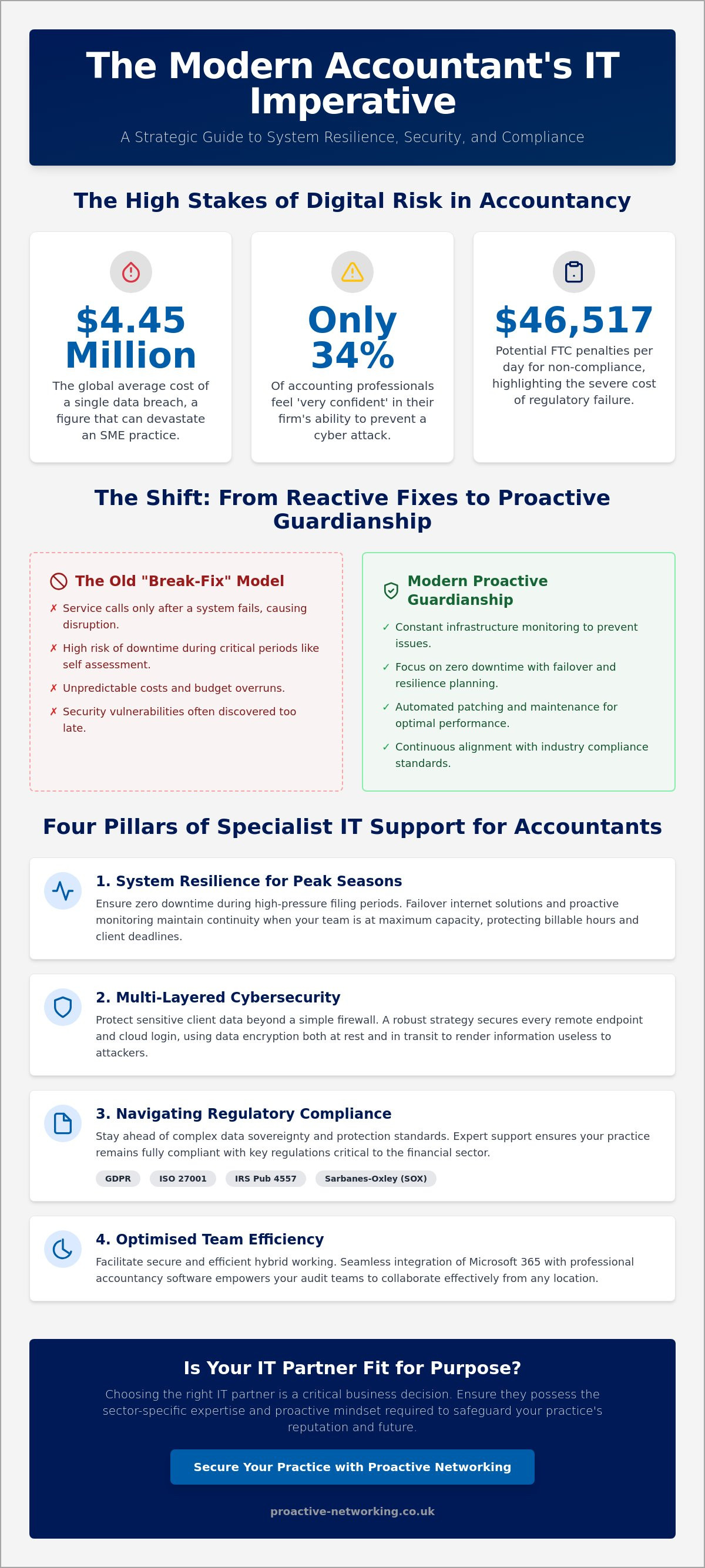
Did you know that the global average cost of a data breach has reached $4.45 million, yet a Thomson Reuters survey reveals that only 34% of accounting professionals feel very confident in their firm's ability to prevent an attack? It's a stark reality for any practice managing sensitive financial records in an era of sophisticated cyber threats. You've likely experienced the frustration of system slowdowns during the self assessment rush or the complexity of managing legacy software alongside modern cloud tools. Specialist IT support for accountants is no longer just a technical luxury; it's a strategic necessity for maintaining system resilience and your professional reputation.
We understand that your focus should remain on providing high level advisory services, not troubleshooting server errors or worrying about FTC penalties that can reach $46,517 per day for non compliance. This reference guide will show you how to achieve zero downtime during your busiest months whilst ensuring your firm remains fully compliant with ISO 27001 and GDPR. We'll examine the proactive measures required to protect your practice, from seamless Microsoft 365 integration to the rigorous technical standards demanded by IRS Publication 4557.
Table of Contents
The Evolving Landscape of IT Support for Accountants in 2026
The accounting sector has undergone a fundamental transformation in how it utilises technology. By 2026, the reliance on digital infrastructure has reached a point where it support for accountants must be viewed as a proactive guardianship of financial data rather than a simple helpdesk service. Generic providers often struggle to appreciate the unique cadence of the accountancy calendar. Whilst a four hour response time might be acceptable for a retail business, it can prove disastrous for a practice facing a self assessment deadline or a critical end of year filing. When every minute translates into billable value, the infrastructure must be as reliable as the advice you provide.
Modern practices have largely moved away from traditional on premise servers, opting instead for sophisticated hybrid cloud environments. This shift demands a more rigorous approach to Information technology controls to maintain the accuracy, confidentiality, and availability of client records. Proactive monitoring now serves as the primary defence against system failures, identifying potential bottlenecks or security vulnerabilities before they can impact your team's productivity. It is about creating a stable foundation that allows your firm to scale without the constant fear of technical friction.
Navigating Peak Season Pressures and System Reliability
System uptime is the lifeblood of any practice during January and other critical filing windows. When your team is working at maximum capacity, even a brief interruption to cloud access can derail an entire week's schedule. This is where failover internet solutions for business become indispensable. By implementing secondary broadband and backup lines, firms ensure that their connection remains uninterrupted, even if the primary provider suffers a local outage. This level of resilience is a hallmark of specialist it support for accountants, prioritising continuity when it matters most to your clients and your bottom line.
The Shift from Reactive Fixes to Proactive Guardianship
The old break fix model is no longer fit for purpose in a regulated financial environment. Modern managed services have replaced reactive repairs with constant infrastructure monitoring. Automated maintenance schedules now handle routine patching and updates, which significantly reduces the risk of hardware failure or software conflicts during busy periods. This methodical approach ensures that systems are always optimised for performance. We define proactive guardianship as the continuous alignment of IT infrastructure with professional accounting standards, ensuring that every technical component supports the firm's broader strategic goals and compliance obligations.
Multi Layered Cyber Security: Protecting Sensitive Financial Data
Accountancy practices are high value targets for cybercriminals because they process vast quantities of sensitive client data and manage large scale financial transactions. A single successful phishing attempt or malware infection can result in devastating reputational damage and severe regulatory penalties. Effective it support for accountants focuses on reducing the attack surface by securing every remote endpoint and cloud login. This involves more than just perimeter defences; it requires a deep understanding of how financial data flows through your organisation whilst maintaining the proactive guardianship established in your core infrastructure.
Encryption is a critical component of this protective layer. By ensuring data is encrypted both at rest and whilst in transit, you provide a final line of defence that renders information useless to unauthorised parties. This level of technical rigour is essential for meeting international standards and ensuring your practice remains aligned with Sarbanes-Oxley (SOX) Compliance. Implementing these controls helps to maintain the integrity of your financial reporting and protects your clients' most valuable assets. To ensure your defences are current, you might consider a specialist cyber security review from Proactive Networking Ltd to identify any potential gaps in your infrastructure.
Beyond Antivirus: EDR and XDR for Accountancy Firms
Traditional antivirus software often fails to detect modern, fileless attacks that don't rely on known malware signatures. Endpoint Detection and Response (EDR) and Extended Detection and Response (XDR) represent a significant step forward. Rather than looking for a specific file, these tools monitor for unusual behaviour amongst users and systems. If an account suddenly begins downloading an atypical volume of files or attempts to connect to a suspicious external server, the system can intervene in real time. This AI driven threat detection provides a level of security that older signature based systems simply cannot match.
Securing the Human Element: Anti Phishing and Sign in Protection
The human element remains the most vulnerable point in any security chain. Business email compromise (BEC) is a persistent threat where attackers impersonate senior partners or clients to authorise fraudulent payments. To combat this, we implement robust domain security protocols including DMARC, SPF and DKIM. These ensure that emails sent from your firm are verified and that spoofed messages from attackers are blocked before they reach your inbox. Combined with multi factor authentication (MFA) and advanced sign in protection, these non negotiable standards create a formidable barrier against unauthorised access. This strategic approach ensures that even if a password is compromised, your client data remains secure.
Regulatory Compliance and Data Sovereignty Standards
Compliance in the accountancy sector is a multi-dimensional challenge. It requires a deep understanding of how GDPR interacts with the professional standards set by bodies like the ICAEW or ACCA. Specialist it support for accountants ensures that every piece of financial data is handled with the precision required by law. This is not just about ticking boxes; it's about building a framework that protects your practice from the severe financial and reputational fallout of a data breach. Regular compliance audits act as a safeguard, ensuring your infrastructure evolves alongside changing legislation.
Data sovereignty has become a critical focal point for firms managing international clients. Knowing exactly where your data resides is paramount for maintaining compliance with UK and EU regulations. Many cloud providers store data in various jurisdictions, which can inadvertently lead to legal complications if not managed correctly. Utilising professional cyber security compliance services UK provides the clarity needed to navigate these complexities. This ensures that client records remain within protected borders and that your firm meets the rigorous expectations of professional regulatory bodies.
ISO 27001 and Cyber Essentials: The Gold Standards
Cyber Essentials serves as a vital baseline for any modern practice. It demonstrates to clients and regulators that you've implemented the fundamental technical controls needed to repel the most common cyber threats. For larger firms or those handling complex corporate accounts, ISO 27001 offers a more comprehensive approach. ISO 27001 certification demonstrates an accountancy firm’s commitment to international information security management standards. This certification provides a structured methodology for managing sensitive information, ensuring that security is woven into the very fabric of your firm's operational culture and daily workflows.
GDPR and Sector-Specific Data Protection Audits
Managing Personally Identifiable Information (PII) during financial audits presents unique risks. Auditors often handle vast amounts of sensitive data that must be strictly controlled and eventually disposed of in accordance with retention policies. Specialist data protection consultancy helps firms avoid the heavy fines associated with ICO investigations whilst ensuring that data handling remains transparent. Additionally, managed IT providers play a crucial role in facilitating secure Data Subject Access Requests (DSARs). By organising data efficiently, your provider ensures that you can respond to these requests promptly and securely, without disrupting your firm's core activities or billable hours.
Optimising Efficiency through Cloud and Communication Systems
Efficiency in a modern practice depends on the synergy between professional software and the underlying infrastructure. Whilst previous sections focused on security and compliance, the operational reality of a firm relies on how well these systems communicate. Integrating Microsoft 365 licensing with core accountancy tools allows for a unified workflow where data moves securely between platforms. This connectivity is particularly beneficial for audit teams and remote staff who require real-time access to client files from various locations. Specialist it support for accountants ensures these integrations remain stable, preventing the version control issues that often plague firms using disparate systems.
Business continuity planning is the cornerstone of this efficiency. It isn't enough to simply have a backup; you must have a tested recovery strategy. We advocate for a hybrid approach, combining local and cloud data backup to provide redundant layers of protection. This structure is designed to meet a 4-hour recovery objective, ensuring that even in the event of a significant system failure, your practice can resume operations with minimal impact on client service. Maintaining this level of resilience allows your team to focus on billable advisory work rather than technical troubleshooting.
Microsoft 365 and Teams Phone System Integration
Communication within a multi-site practice can often become fragmented. Implementing Microsoft Teams phone system integration simplifies firm communications by consolidating voice calls, video conferencing, and internal chat into a single interface. This transition offers significant cost-saving benefits, as it eliminates the need for expensive traditional PBX hardware and separate line rentals. Beyond cost, it enhances secure document collaboration; staff can discuss sensitive tax returns or audit findings whilst simultaneously editing documents within the protected Microsoft 365 ecosystem. This streamlined approach ensures that your team remains connected, whether they are in the office or at a client site.
Managing Data Mergers and Separations during Practice Growth
Growth through acquisition brings complex technical challenges that generic IT providers frequently overlook. When one accountancy practice acquires another, the process of company data mergers requires meticulous planning to ensure data integrity. Mapping disparate folder structures, migrating legacy email archives, and aligning security permissions demand a high degree of technical precision. Conversely, data separation is equally complex when a partner or specific office splits from the main firm. This involves cleanly extracting specific client records and historical data without compromising the remaining firm's security or operational continuity. If your practice is planning a merger or restructuring, our specialists provide the IT maintenance and monitoring required to manage these transitions without data loss.
Selecting the Right IT Partner for Your Accountancy Practice
Choosing an IT partner is a decision that impacts your firm’s security and its operational efficiency. For accountants, generic technical support is insufficient. You need a partner with sector-specific knowledge who understands the high-stakes nature of financial deadlines. It’s vital to work with experts who also provide it support for financial services and it support for solicitors. These overlapping disciplines ensure the provider is well-versed in the stringent regulatory environments and high-security requirements common to all professional services.
A true specialist understands the nuances of the software that drives your practice. Whether your firm relies on Sage, IRIS, or Xero, your IT partner must ensure these tools integrate flawlessly with your broader infrastructure. This expertise prevents the common "finger-pointing" between software vendors and IT support when issues arise. Rather than a reactive helpdesk that merely fixes what's broken, look for a proactive consultant who anticipates challenges. This strategic alignment ensures your it support for accountants becomes a catalyst for growth rather than a recurring overhead.
The Proactive Networking Ltd Approach: 25 Years of Expertise
Proactive Networking Ltd has spent over 25 years acting as a protective guardian for SMEs with complex security needs. We recognise that managing multiple vendors for broadband, security, and compliance often leads to gaps in protection. By providing a single point of accountability, we simplify your technical landscape whilst maintaining high-tier standards. Our philosophy focuses on making mastery accessible; we handle the technical complexities so you can focus on your clients. This steady, methodical approach ensures that your firm remains resilient against evolving threats.
Next Steps: Securing Your Practice for the Future
If your current IT provision feels reactive or struggles to keep pace with the accountancy calendar, it may be time for a formal audit. Transitioning to a managed provider is a structured process designed to minimise disruption. Consider this checklist for your next review:
Does your provider offer a tested 4-hour recovery objective for business continuity?
Are they actively managing your ISO 27001 or Cyber Essentials compliance?
Do they provide dedicated broadband and backup lines to ensure cloud access?
Is their support rhythm tailored to the January peak period and other filing deadlines?
Securing your practice's future starts with an informed conversation. We invite you to book a sector-specific consultancy session to explore how our strategic it support for accountants can protect your data and streamline your operations for 2026 and beyond.
Future-Proofing Your Accountancy Practice through Strategic IT
The transition from reactive troubleshooting to proactive guardianship is essential for any firm aiming to thrive in 2026. As discussed, the implementation of advanced security protocols and rigorous compliance frameworks protects your practice from the sophisticated threats targeting financial records. Aligning your infrastructure with international standards ensures that regulatory requirements become a competitive advantage rather than a logistical burden. Specialist it support for accountants provides the stability required to navigate peak filing periods whilst maintaining the highest levels of data integrity.
With over 25 years of experience in managed IT services, we specialise in ISO 27001, Cyber Essentials and GDPR compliance. Our approach integrates advanced security featuring EDR and XDR to reduce your attack surface effectively. It is about providing the technical foresight needed to simplify your digital landscape so you can focus on your clients. Secure your practice with specialist IT support from Proactive Networking Ltd and ensure your firm is equipped for the challenges of the future. With a dependable partner, you can lead your practice with absolute technical confidence.
Frequently Asked Questions
Is IT support for accountants different from general business IT support?
Specialist it support for accountants differs significantly from generic services because it aligns technical infrastructure with professional regulatory standards. Whilst general support focuses on basic connectivity, a specialist provider understands the critical importance of zero-downtime during peak filing seasons. We prioritise the specific software integrations and security protocols mandated by the financial sector, ensuring your practice remains both operational and compliant under high-pressure conditions.
How does managed IT help with GDPR compliance for accountancy firms?
Managed IT provides the technical framework required to satisfy GDPR's rigorous data sovereignty and protection requirements. We implement local and cloud data backup solutions alongside robust encryption to ensure client records are stored and transmitted securely. By conducting regular sector specific compliance audits, we help your firm demonstrate accountability to regulators whilst protecting you from the severe financial penalties associated with data mishandling.
Can my accountancy firm use Microsoft Teams as its primary phone system?
You can use Microsoft Teams as a professional phone system to consolidate your firm’s communications. This integration allows your staff to make and receive external calls directly within the same platform they use for internal collaboration and document sharing. It’s a cost-effective solution that supports hybrid working, enabling audit teams and remote staff to remain connected using a single, secure business number.
What happens if our internet goes down during the self-assessment deadline?
We mitigate the risk of downtime by installing broadband and backup lines that provide automatic failover. If your primary connection suffers an outage during a critical filing window, your system will instantly switch to a secondary line to maintain cloud access. This level of resilience is a standard component of our it support for accountants, ensuring that your practice remains productive when every billable hour counts.
Do you support specific accountancy software like Sage, IRIS and Xero?
Our engineers provide comprehensive management for the core applications that drive your practice, including Sage, IRIS, and Xero. We handle the underlying infrastructure, Microsoft 365 licensing, and security patching to ensure these tools operate seamlessly within your environment. This holistic approach prevents software conflicts and ensures that your technical stack remains stable, even as these applications evolve through regular updates.
What is the difference between EDR and traditional antivirus for financial data?
Traditional antivirus relies on a database of known threat signatures, whilst EDR (Endpoint Detection and Response) monitors system behaviour in real time. EDR is significantly more effective for accountancy firms because it can identify and block sophisticated, fileless attacks that don't have a recognisable signature. By detecting unusual patterns, such as unauthorised mass data movements, EDR provides a proactive layer of guardianship that traditional antivirus cannot match.
How long does it take to recover data if our practice suffers a cyber attack?
Our business continuity plans are designed to meet a 4-hour recovery objective following a cyber incident. This rapid restoration is achieved through a combination of local and cloud data backup systems that are tested regularly for reliability. By having redundant, clean copies of your financial records available, we can bypass compromised systems and restore your firm's critical operations with minimal disruption to your professional schedule.
Can you help with IT infrastructure during a practice merger or acquisition?
Practice growth requires precise technical management during company data mergers and separations. We handle the complex task of migrating legacy archives and aligning security permissions when one firm acquires another. This process ensures that data integrity is preserved and that the new practice infrastructure is fully integrated, secure, and compliant with current professional standards from the moment the merger is finalised.


Comments