


How to Reduce Your Cyber Attack Surface: A Practical Guide for UK SMEs
- Simon Raine
- 1 day ago
- 12 min read
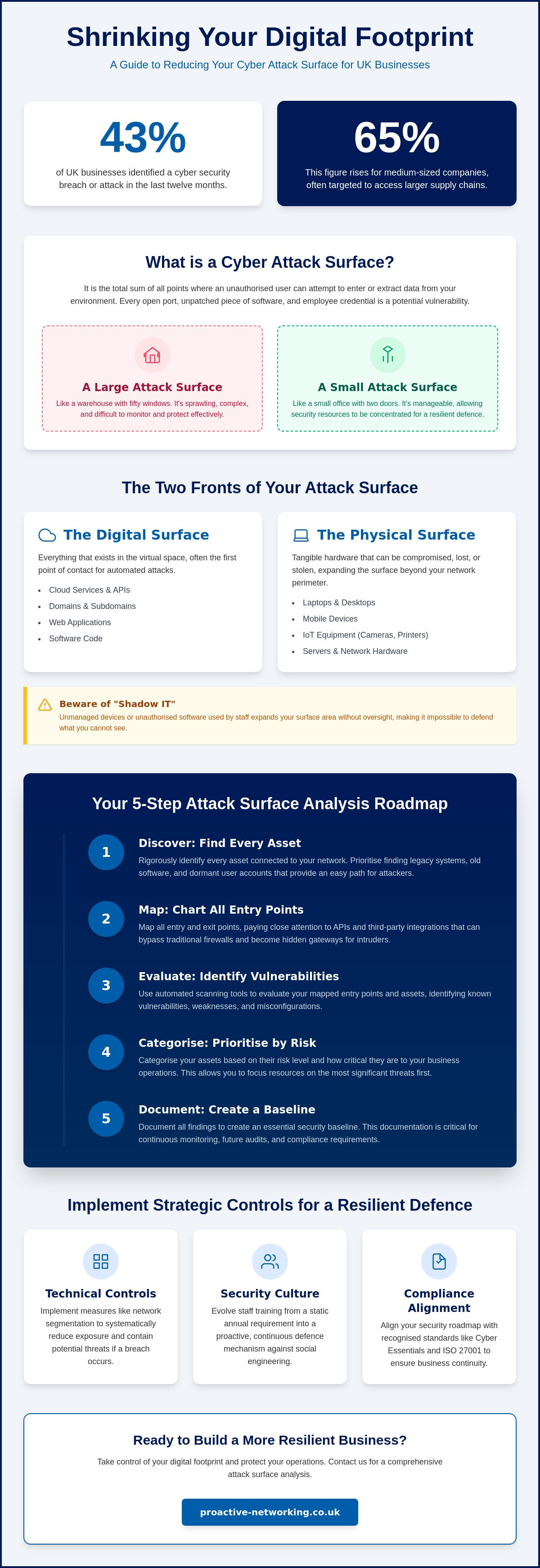
Did you know that 43% of UK businesses identified a cyber security breach or attack in the last twelve months? This figure rises to 65% for medium sized companies, highlighting a trend where attackers target smaller firms to gain access to larger supply chains. For many business owners, the digital environment feels like an ever expanding map of hidden risks and confusing jargon. However, the most effective way to protect your operations is not through massive, unmanageable overhauls, but by learning how to reduce cyber attack surface areas through ruthless simplification and proactive discipline.
We understand that security often feels like a choice between overextending your budget or leaving the door unlocked. It's common to feel unsettled by vulnerabilities you cannot see, particularly when high tier solutions seem designed only for global corporations. This guide provides a strategic roadmap to identify, map, and shrink your business's digital footprint without disrupting your daily operations. You'll learn the practical steps to achieve peace of mind and ensure your firm aligns with essential standards like Cyber Essentials or ISO 27001, providing a clear path toward long term resilience.
Table of Contents
What Is a Cyber Attack Surface and Why Does Size Matter?
To secure a modern business, you must first understand the perimeter. In technical terms, what is an attack surface? It's the total sum of all points where an unauthorised user can attempt to enter or extract data from your environment. Every open port, every unpatched piece of software, and every employee with access credentials represents a potential vulnerability. These vulnerabilities are the "where" of your security posture, whilst "attack vectors" are the "how", representing the specific paths or methods an intruder might use to exploit those gaps.
Size is the most critical factor in this equation. A sprawling digital footprint is inherently difficult to monitor and protect. Think of your business like a building; a small office with two doors is far easier to lock down than a warehouse with fifty windows and a dozen loading bays. When you work to reduce cyber attack surface areas, you aren't just deleting old files. You're systematically removing the targets that criminals use to gain a foothold in your network. A smaller surface area allows your security resources to be concentrated, creating a more resilient and manageable defence.
The Digital vs Physical Attack Surface
Your digital attack surface consists of everything that exists in the virtual space. This includes cloud services, domains, web applications, and even the code within your proprietary software. These assets are often the first points of contact for automated scripts looking for a way in. In contrast, the physical surface involves tangible hardware such as laptops, mobile devices, and IoT equipment like smart cameras or printers. A significant challenge for many UK firms is "shadow IT". This occurs when staff use unmanaged devices or unauthorised software without the IT department's knowledge. These rogue assets expand your surface area without any oversight, making it impossible to defend what you cannot see.
Why SMEs Are High Value Targets in 2026
In 2026, attackers aren't necessarily looking for a specific brand; they're looking for an open door. Automated tools scan the internet for known vulnerabilities, and small businesses often lack the enterprise grade monitoring that larger firms employ. A breach doesn't just result in temporary downtime. It triggers a ripple effect that damages client trust and can lead to severe GDPR compliance penalties. For a broader look at defensive strategies, our Comprehensive Guide to Multi-Layered Cyber Security for SMEs in 2026 provides additional context on building a robust shield. By taking steps to reduce cyber attack surface vulnerabilities now, you protect your reputation and ensure your business remains a difficult target for opportunistic threats.
How to Conduct a Comprehensive Attack Surface Analysis
Analysis is the foundation of any resilient security strategy. To effectively reduce cyber attack surface risks, you must move beyond guesswork and establish a definitive inventory of your digital estate. This process begins with a rigorous five step methodology designed to bring clarity to complex environments. First, discover every asset connected to your network, including those that may have slipped through previous audits. Second, map all entry and exit points, paying close attention to APIs and third party integrations that often bypass traditional firewalls. Third, evaluate these points using automated scanning tools to identify known vulnerabilities. Fourth, categorise your assets based on their risk level and how critical they are to your business operations. Finally, document these findings to create the essential baseline required for continuous monitoring and future compliance audits.
Inventory Management: Finding Your Hidden Assets
Identifying legacy systems is a priority for any SME. Old servers or software versions that are no longer in use but remain connected provide an easy path for attackers looking for unpatched vulnerabilities. You should also audit cloud permissions and dormant user accounts regularly; if an employee has left the company but their access remains active, your surface area is unnecessarily large. Utilising managed domain hosting helps you identify "forgotten" subdomains that might be running insecure legacy applications, allowing you to close these gaps before they are exploited. This level of oversight ensures that your infrastructure remains lean and purposeful.
Threat Modelling for Small Business Operations
Visualising the path of an intruder helps you understand your weaknesses before they are tested by a real world attack. A single phishing email can lead to a full network breach if lateral movement isn't restricted by proper controls. You must identify your "crown jewels", such as sensitive client records or financial data, and build your defences specifically around these high value targets. Referencing the NCSC's Small Business Guide provides a structured way to understand these risks within the UK's specific regulatory environment. By staying informed on which vulnerabilities are currently being exploited amongst UK firms, you can prioritise your security efforts where they will have the most significant impact on your business continuity.
Strategic Technical Controls to Minimise Your Vulnerabilities
Once you've mapped your assets, the focus shifts to active fortification. To effectively reduce cyber attack surface vulnerabilities, you must implement technical controls that limit an attacker's ability to move through your network. For most UK SMEs, this begins with hardening the Microsoft 365 environment. It's common for default settings to leave legacy protocols active, providing an unnecessary back door for intruders. By disabling unused features and protocols, you create a leaner, more secure digital footprint that's far easier to defend. This proactive approach ensures your primary productivity tool doesn't become your greatest liability.
Applying the Principle of Least Privilege (PoLP) ensures that users only have the access necessary for their specific roles. This simple discipline prevents a compromised account from becoming a gateway to your entire database. Additionally, maintaining a rigorous patching schedule is vital. As of 2026, Cyber Essentials requires critical patches to be applied within 14 days. Automated software updates remove the risk of human error, ensuring your systems are protected against known exploits as soon as a fix is available. These steps aren't just about compliance; they're about building a dependable foundation for your operations.
Network Segmentation and Zero Trust Architecture
Dividing your network into smaller, isolated zones is a core component of Zero Trust architecture. This "never trust, always verify" mindset ensures that even if one area is compromised, the threat is contained and cannot spread laterally. This is particularly important for firms handling sensitive financial or legal data where isolation is a prerequisite for security. For those seeking advanced endpoint protection, our comparison of EDR and XDR Security Solutions: A Comparison for UK SMEs in 2026 details how these technologies provide deep visibility into network behaviour and automate the response to potential threats.
Securing Entry Points: Email and Sign-in Protection
Email remains the most frequent point of entry for cyber criminals. Mandating Multi-Factor Authentication (MFA) is a non-negotiable barrier that stops the vast majority of automated sign-in attempts. You should also configure DMARC, SPF, and DKIM settings to protect your business domain from being spoofed by malicious actors. These protocols act as a digital signature, verifying your identity to recipients and blocking fraudulent messages. Following the NCSC Small Business Guide will help you implement these configurations correctly. This level of sign-in protection is critical for remote and hybrid workforces, ensuring your security posture remains stable regardless of where your team is logged in.
Addressing the Human Element and Social Engineering Risks
Whilst technical barriers are essential, the human element remains the most unpredictable part of your digital footprint. In many ways, your staff are the "softest" part of the attack surface because social engineering bypasses firewalls by exploiting trust. To truly reduce cyber attack surface risks, you must evolve your team from a potential vulnerability into a proactive line of defence. This requires a shift away from dry, annual slide decks toward a continuous security awareness programme. Regular, bite-sized training keeps security at the forefront of the daily workflow without overwhelming your staff.
Establishing clear reporting procedures is a fundamental step in this evolution. If an employee suspects they've encountered a threat, they need to know exactly who to contact and what information to provide. Simulated phishing attacks play a vital role here, acting as a controlled test of your business resilience. These simulations shouldn't be used to catch people out, but to provide teachable moments that sharpen the team's ability to recognise sophisticated threats in a safe environment. When your team understands the "why" behind the rules, they become much more effective at spotting anomalies.
Building a Security-First Culture
A resilient culture is built on transparency rather than blame. When a mistake occurs, such as a clicked link or a shared password, the priority must be immediate reporting to contain the damage. A "blame culture" encourages concealment, which only gives an attacker more time to embed themselves in your systems. By using real world examples of phishing tactics during team meetings, you can demystify the methods criminals use. Integrating simple security checks into the daily routine ensures that protection becomes a shared responsibility rather than an IT department burden.
Phishing Defence and Email Hygiene
Modern criminals often use "Business Email Compromise" (BEC) to target finance departments with convincing, high pressure requests. These attempts often involve spoofing a senior leader's email to request an urgent bank transfer. We recommend your team follows the Comprehensive Anti-Phishing Protection Checklist for Businesses in 2026 to verify incoming messages. A simple but effective rule is to always verify unusual financial requests via a secondary communication channel, such as a phone call or a separate messaging app. If you are ready to fortify your team's defences, our cyber security experts can help you implement a managed training programme tailored to your specific sector.
Implementing a Managed Approach to Attack Surface Reduction
Managing a digital estate is a full time commitment that often exceeds the capacity of internal teams. By partnering with a proactive IT provider, you move beyond the limitations of manual oversight and adopt a systematic method to reduce cyber attack surface exposure. This managed approach transitions your business from a state of reactive firefighting to one of proactive threat hunting. Instead of waiting for an alert to signal a breach, continuous monitoring identifies and neutralises vulnerabilities as they emerge. In the fast moving environment of 2026, this level of vigilance is essential for maintaining operational stability. It allows your leadership team to focus on growth, whilst Proactive Networking Ltd acts as the protective guardian of your technical infrastructure.
Aligning with UK Security Standards
Strict adherence to recognised frameworks is a hallmark of a mature security posture. For UK SMEs, the process to reduce cyber attack surface vulnerabilities directly supports the requirements for Cyber Essentials and Cyber Essentials Plus. These government backed certifications prove to clients and partners that you've implemented the five key technical controls correctly. For law firms, barristers, and financial services, the more rigorous ISO 27001 standard provides a comprehensive framework for managing information security risks. Maintaining these certifications through disciplined surface management ensures you're always prepared for regulatory audits. It provides documented evidence of your commitment to GDPR compliance, which is vital for maintaining professional credibility in highly regulated sectors.
The Role of Advanced Threat Detection
Even the most streamlined attack surface requires a robust safety net. Advanced Threat Detection Services provide this critical layer of protection by monitoring the remaining surface for any anomalous activity. In a global threat landscape where attackers operate across all time zones, 24/7 monitoring is no longer a luxury reserved for large corporations. It's a necessity for any business with a digital presence. Real time visibility allows for the immediate isolation of suspicious behaviour, preventing a minor incident from escalating into a full scale crisis. This level of sophisticated protection instils a sense of relief. You can rest assured knowing your operations are being guarded by experts who understand the nuances of modern cyber crime and are prepared to act instantly.
If you're ready to secure your digital footprint and achieve lasting peace of mind, organise a security audit with Proactive Networking Ltd today. Our team will help you map your assets, identify hidden risks, and implement a manageable roadmap for continuous protection.
Building a Resilient Digital Foundation for Your Business
Securing your business in an increasingly complex digital landscape requires more than just reactive measures. By establishing a clear inventory of your assets and implementing disciplined technical controls, you can effectively reduce cyber attack surface exposure and protect your long term interests. We've explored how a combination of network segmentation, user access management, and a security first culture creates a robust defence against modern threats. These steps ensure your operations remain stable whilst providing the transparency required for high level compliance.
With over 25 years of IT experience, Proactive Networking Ltd acts as a dedicated guardian for firms across the UK. We are Cyber Essentials and ISO 27001 specialists, with deep expertise in managing the unique compliance requirements of the legal and finance sectors. Our team simplifies the technical landscape, allowing you to focus on your core objectives with total peace of mind.
If you're ready to identify your vulnerabilities and strengthen your perimeter, Request a Comprehensive Cyber Security Audit today. Taking these strategic steps now ensures your business remains a difficult target and stays prepared for the challenges of tomorrow.
Frequently Asked Questions
What is the most common way an attack surface expands?
The most common cause of expansion is the proliferation of unmanaged assets and shadow IT. When employees use personal devices or unauthorised software for work, they create entry points that the IT department cannot monitor. These hidden assets expand the perimeter without oversight, making it impossible to apply consistent security controls. This lack of visibility is often the primary reason a business's digital footprint becomes unmanageable and insecure.
Can I completely eliminate my cyber attack surface?
You cannot completely eliminate your attack surface if you intend to remain operational and connected to the internet. Every digital interaction or connected device carries an inherent risk that must be managed. The objective is to reduce cyber attack surface vulnerabilities to a manageable level, ensuring that the remaining exposure is heavily monitored and protected by robust technical controls that align with your business continuity plans.
How often should I perform an attack surface analysis?
You should perform a formal analysis at least quarterly, though continuous monitoring is the preferred standard for modern firms. Digital environments are dynamic; new software updates, cloud integrations, and employee changes occur daily. Regular reviews ensure that legacy systems are decommissioned and that new assets are properly secured before they become targets. This methodical approach ensures your security posture remains stable despite constant changes to your infrastructure.
Does moving to the cloud reduce my attack surface?
Moving to the cloud shifts your security responsibility rather than automatically shrinking your surface. Whilst cloud providers secure the underlying infrastructure, you remain responsible for securing your data, user access, and configurations. Misconfigured cloud buckets or overly permissive accounts can actually expand your surface area if they aren't managed with a Zero Trust mindset. Proper configuration is essential to ensure the cloud remains a secure asset.
What is the difference between a vulnerability and an attack vector?
A vulnerability is a specific flaw or weakness in your system, whilst an attack vector is the path an intruder takes to exploit that flaw. For example, an unpatched software version is the vulnerability. The phishing email used to deliver malware that targets that specific software is the attack vector. Understanding both is essential for effective defence, as it allows you to close gaps and block the paths to them.
How does Cyber Essentials help in reducing my attack surface?
Cyber Essentials provides a structured framework that mandates five essential technical controls to reduce cyber attack surface exposure. By enforcing firewalls, secure configurations, user access controls, malware protection, and security update management, the scheme addresses the most common vulnerabilities. This creates a dependable baseline that protects against the majority of automated cyber attacks, providing a clear roadmap for small businesses to follow.
What are the first three steps an SME should take to shrink their surface?
The first three steps are to conduct a full asset inventory, mandate Multi-Factor Authentication (MFA), and implement a rigorous patching schedule. You cannot protect what you don't know exists, so discovery is the priority. MFA and patching then close the most frequently exploited entry points, providing immediate and significant improvements. These actions establish a sense of control and order over your business's digital footprint.
Is shadow IT a significant risk for small UK businesses?
Shadow IT is a critical risk for UK SMEs because it creates blind spots that bypass traditional security monitoring. When staff install third party applications or use unmanaged cloud storage, they often inadvertently expose sensitive company data. Without central oversight, these services remain unpatched and poorly configured, providing an easy foothold for criminals. Managing this risk requires a culture of transparency where staff feel supported in using approved tools.


Comments