


Cyber Security for Schools UK: A Professional Guide to DfE Compliance in 2026
- Simon Raine
- 4 days ago
- 12 min read
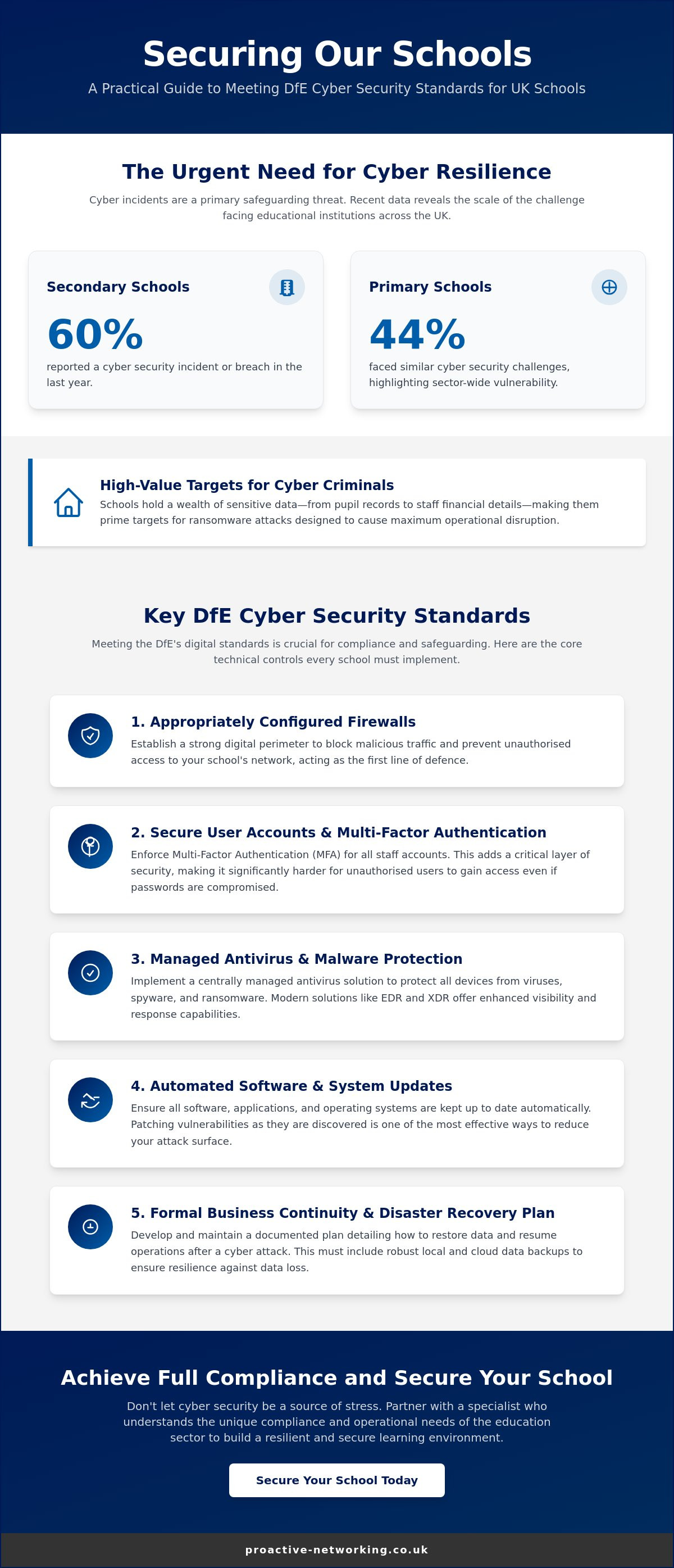
With 60% of secondary schools and 44% of primary schools in the UK reporting a cyber security incident in 2025, the digital safety of our classrooms is no longer just a technical concern; it's a fundamental safeguarding priority. Ensuring robust cyber security for schools UK is essential to protect both staff and pupils from the growing threat of ransomware that can disrupt learning in an instant.
We understand that implementing the April 2026 DfE digital and technology standards can feel daunting, particularly when trying to reconcile official guidance with practical implementation. You may find yourself balancing the need for advanced tools like EDR and XDR against a lack of specialised in-house expertise. This guide simplifies that complex landscape, offering a structured approach to achieving full compliance and securing your learning environment.
By following this professional roadmap, you'll discover how to meet the seven core cyber security standards whilst building a resilient disaster recovery plan. We'll explore the transition from reactive measures to proactive defence, ensuring your institution remains a secure and dependable space for education.
Key Takeaways
Understand why digital safety is now a core safeguarding duty and how to protect your institution from sophisticated ransomware attacks.
Learn how to align your school with the 2026 DfE digital standards and the role of Cyber Essentials in securing cyber security for schools UK.
Discover the benefits of upgrading to EDR and XDR solutions to gain a comprehensive view of your digital estate and reduce your attack surface.
Establish a robust business continuity plan that combines local and cloud data backups to ensure your school remains resilient against data loss.
Identify the specific advantages of partnering with a specialist provider who understands the unique compliance and operational needs of the education sector.
Table of Contents
The Current Landscape of Cyber Security for Schools UK
The digital environment in which our educational institutions operate has shifted from a supportive tool to a critical infrastructure. This evolution means that cyber security for schools UK is no longer a secondary concern for the IT department; it is now a primary safeguarding priority. Protecting the digital perimeter is as essential as securing the school gates, particularly as threats become more targeted and sophisticated. The National Cyber Security Centre (NCSC) provides the foundational guidance for this protection, yet many schools still struggle to move beyond basic awareness into a state of true resilience.
Legal obligations under UK GDPR have raised the stakes for every headteacher and governor. A data breach is not merely a technical failure but a significant legal liability that can result in heavy fines and long term reputational damage. We are seeing a necessary transition across the sector. Schools are moving away from reactive break fix IT models, where problems are addressed only after they occur, toward proactive security management. This strategic shift ensures that defences are constantly monitored and updated, creating a stable environment where learning remains the focus.
Why Educational Institutions are High Value Targets
Cyber criminals view schools as high value targets because they house a gold mine of sensitive information. This includes pupil records, safeguarding data, and staff financial details. According to a 2025 government survey, 60% of secondary schools reported a cyber security incident in the previous year. These attackers don't just want data; they want to cause operational paralysis. By exploiting the open nature of school networks, which often support numerous personal devices, ransomware can quickly lock down systems. This disruption is most damaging during examination periods or enrolment, when downtime is not an option.
The Role of Safeguarding in Digital Security
Modern safeguarding must encompass the digital world. Robust filtering and monitoring systems are vital to protect pupils from online harm, but the human element remains a significant vulnerability. Staff must be empowered to recognise sophisticated phishing attempts that bypass traditional filters. When an organisation prioritises cyber resilience, it sends a clear message to parents and the wider community that pupil safety is managed with professional diligence. Digital security is now a pillar of school reputation, ensuring that the trust placed in the institution by families is never compromised by a preventable technical failure.
Meeting DfE Digital Standards and NCSC Requirements
Schools are expected to meet the DfE's digital and technology standards by 2030, but the pressure to demonstrate progress is immediate. These guidelines serve as the benchmark for modern audits and safeguarding inspections. Achieving robust cyber security for schools UK requires a methodical approach that combines technical controls with clear governance. It's about moving beyond simple checklists to create a culture of digital resilience that protects every member of the school community.
Leadership teams should also engage with the NCSC Board Toolkit. This resource helps governors and trustees ask the right questions about their school's digital health, shifting the focus from basic connectivity to long term data resilience. Coupling this with regular GDPR audits ensures that compliance isn't a one off event but a continuous process of improvement. This structured oversight provides the reassuring stability that parents and staff expect from a modern educational institution.
The Core DfE Standards for Cyber Security
The DfE defines seven specific standards that every institution must address. Central to these is the requirement for appropriately configured firewalls and secure user accounts. This involves enforcing multi-factor authentication (MFA) for all staff accounts to prevent unauthorised access. Schools must also ensure they have managed antivirus solutions and automated update processes in place. A critical requirement is a formal business continuity plan. This document must detail exactly how the school will restore data and resume operations following a breach, ensuring that resilience is built into the school's daily operations.
Achieving Cyber Essentials in Education
While the DfE standards provide the framework, Cyber Essentials certification offers the technical validation. This government backed scheme focuses on five essential controls: firewalls, secure configuration, user access control, malware protection, and patch management. For many academy trusts, holding Cyber Essentials Plus is now a prerequisite for accessing specific government grants and procurement frameworks. It also acts as a vital indicator for insurers, which can lead to more manageable premiums. Preparing for this audit requires precision, and it's often beneficial to work with a partner who can provide Cyber Essentials and GDPR compliance services to ensure every technical requirement is met before the assessment begins.
Advanced Protection: EDR, XDR and Attack Surface Reduction
Firewalls and standard antivirus solutions are necessary foundations, but they aren't enough to stop the sophisticated threats schools face today. High tier cyber security for schools UK requires a transition toward behavioural analysis and automated response. Modern attackers frequently use techniques that don't rely on known file signatures, allowing them to slip past traditional defences unnoticed. This is why advanced detection technologies are now vital for maintaining a secure learning environment.
EDR vs Traditional Antivirus: What Schools Need to Know
Signature based antivirus functions like a digital wanted poster; it only catches threats it has seen before. If a new piece of malware is released, your systems are vulnerable. Endpoint Detection and Response (EDR) moves beyond this by monitoring the behaviour of every process on a device. It looks for suspicious patterns, such as a file suddenly attempting to encrypt a database. When EDR detects these anomalies, it can automatically isolate the affected device from the network. This proactive approach significantly reduces the pressure on internal IT staff who can't realistically monitor every device around the clock.
Extended Detection and Response (XDR) takes this visibility even further. It integrates data from your servers, cloud applications, and email systems into a single, unified view. Having this holistic perspective is essential for attack surface reduction. In a school setting, where numerous devices connect to the network simultaneously, XDR allows you to identify and close security gaps before they can be exploited. It provides the strategic foresight needed to protect sensitive pupil data across your entire digital estate.
Securing School Emails and Sign-ins
Phishing attempts are the most common entry point for ransomware. Protecting your school's reputation and data requires a robust approach to email security. Implementing managed domain hosting that includes DMARC, SPF and DKIM is a critical step. These protocols verify that emails sent from your domain are legitimate, preventing criminals from spoofing your school's identity to deceive staff or parents. It's a professional standard that instils confidence in your digital communications.
Securing user access is equally important. Multi-factor authentication (MFA) is the most effective tool available for preventing unauthorised sign-ins. We recommend implementing MFA alongside an audit of your Microsoft 365 licensing. Many schools aren't aware that their current license might already include advanced security features like automated anti-phishing and sign-in protection. Optimising these settings ensures you're getting the best possible value and protection from your existing investments, whilst keeping the login process simple for staff.
Ensuring Data Resilience and Business Continuity
Many schools mistake a weekly backup for a comprehensive resilience strategy. In reality, achieving high tier cyber security for schools UK requires a formal business continuity plan that accounts for both data loss and operational downtime. This plan must define your Recovery Time Objective (RTO), which is the maximum amount of time your school can realistically function without access to its digital systems before the impact on learning and safeguarding becomes critical. Knowing these thresholds allows you to build an infrastructure that is truly dependable.
Resilience isn't just about having a copy of your files; it's about the speed and reliability of the recovery process. We've seen that schools with a structured approach to continuity recover from incidents significantly faster than those relying on ad hoc solutions. By moving from a reactive mindset to a proactive one, you ensure that your institution remains a stable and secure environment for both pupils and staff, regardless of the technical challenges you might face.
Managed Backup Solutions for Education
Protecting the Management Information System (MIS) and student coursework is a non negotiable priority. We implement the "3-2-1" rule for all educational clients: keep three copies of your data, on two different media types, with one copy stored securely offsite in the cloud. This redundancy ensures that even if your local hardware fails or your physical site is inaccessible, your data remains protected. However, a backup is only useful if it actually works. We perform regular, documented tests of recovery procedures to ensure that data isn't just being stored, but can be fully restored within your defined RTO.
Maintaining Connectivity with Failover Lines
In 2026, a school without an internet connection is a school that cannot function. With the total shift toward cloud based learning and administrative tools, downtime is no longer just an inconvenience; it's a total operational halt. This is why we prioritise the implementation of failover internet solutions for business to ensure constant connectivity. A failover line acts as an automatic safety net, switching your school's traffic to a secondary connection the moment your primary line fails.
Integrating these secondary lines into your broader IT infrastructure provides the reassuring stability that modern education demands. It prevents the disruption of online examinations and ensures that safeguarding monitoring remains active at all times. If you are concerned about your current level of resilience, our team can help you implement a robust business continuity plan that guarantees your school stays online and protected.
Choosing a Specialist Partner for School IT Support
Generalist IT providers often struggle to meet the specific demands of the education sector because they treat schools like standard corporate offices. A school's digital environment requires a nuanced understanding of safeguarding, DfE standards, and the intense pressure of academic cycles. Selecting a partner with 25 years of experience in managed IT support ensures you have a guardian who understands that a network failure during an Ofsted inspection or an exam period is more than a technical glitch; it's a threat to the institution's primary mission. Professional cyber security for schools UK demands this level of sector specific expertise.
A sophisticated partner doesn't just fix problems; they provide strategic foresight. This includes modernising your communication infrastructure by integrating Microsoft Teams as a secure phone system. By using Teams as your primary telephony solution, you simplify your hardware footprint whilst ensuring that staff can communicate safely and reliably from any location. It's this blend of technical capability and functional benefit that characterises a high tier managed service.
Education Technology and Managed Support
We've spent over two decades tailoring managed IT support for small business UK to meet the rigorous standards of the education sector. This experience is vital during complex transitions, such as academy conversions, where we manage company data mergers and separations with precision. Our proactive monitoring approach ensures that your school network is constantly scanned for vulnerabilities, allowing us to resolve potential issues before they impact the classroom. This creates a sense of order and control that allows your teaching staff to focus entirely on pupil outcomes.
The Proactive Networking Ltd Approach to School Security
Our commitment to providing cyber security compliance services UK means we don't just offer advice; we deliver a secure, audited infrastructure. Proactive Networking Ltd provides specialised consultancy that bridges the gap between technical requirements and the legal or financial compliance needs of your school or trust. We act as a steady leader, making the mastery of complex technical landscapes accessible to your leadership team. To ensure your institution meets the 2026 standards, the next step is simple.
Book a comprehensive security audit to identify current gaps in your DfE compliance.
Review your existing Microsoft 365 licensing to unlock hidden security features.
Evaluate your current business continuity plan against real world recovery time objectives.
Discuss the implementation of EDR and XDR to move toward a proactive defence posture.
Securing your school's future starts with a professional assessment. By partnering with a seasoned expert like Proactive Networking Ltd, you gain the peace of mind that comes from knowing your digital estate is protected by a dedicated guardian.
Securing the Future of Your Educational Institution
Transitioning from reactive IT to proactive security management is the most effective way to meet the 2026 DfE standards. Protecting pupil data and ensuring operational continuity requires a layered approach that moves beyond basic antivirus. By implementing advanced detection tools like EDR and prioritising data resilience through the 3-2-1 backup rule, your school can stay ahead of increasingly sophisticated threats.
Maintaining robust cyber security for schools UK is a continuous commitment that safeguards your reputation and the safety of your students. With over 25 years of experience in managed IT support, we specialise in aligning educational institutions with Cyber Essentials and ISO 27001 compliance. Our expertise in Microsoft 365 and Teams integration ensures your staff can work securely without technical friction.
Take the first step toward a more resilient digital estate. Secure your school with a professional DfE compliance audit today. You don't have to navigate these technical complexities alone; a stable and compliant future for your school is well within reach.
Frequently Asked Questions
What are the DfE digital standards for school cyber security?
The Department for Education has defined seven core standards that schools must work towards to ensure digital safety. These include conducting annual risk assessments, implementing staff and student awareness plans, and securing data with firewalls and anti-malware. They also mandate controlled user access, licensed technology updates, and robust backup procedures. Meeting these benchmarks is essential for any institution prioritising cyber security for schools UK.
Is Cyber Essentials mandatory for UK schools?
While Cyber Essentials isn't a legal requirement for all schools, it's increasingly becoming a prerequisite for government funding and academy trust frameworks. Holding this certification demonstrates that your institution has implemented the five essential technical controls. It also provides a professional benchmark that can lead to lower insurance premiums and greater stakeholder confidence.
How much does managed cyber security for schools cost?
The investment required for managed security depends on the size of your school and the complexity of your existing infrastructure. Factors such as the number of pupils, the level of proactive monitoring required, and your compliance goals will influence the final figure. We recommend a professional audit to determine a strategy that balances comprehensive protection with your specific budgetary constraints.
What is the difference between EDR and antivirus for education?
Traditional antivirus relies on a database of known threats to block malware. In contrast, Endpoint Detection and Response (EDR) monitors system behaviour in real time to identify and isolate suspicious activity before it can cause damage. This proactive approach is vital for schools, as it can detect "zero day" attacks that standard antivirus would likely miss.
How can we protect our school from ransomware attacks?
Protecting your school from ransomware requires a multi layered defence strategy. This starts with enforcing multi-factor authentication (MFA) on all accounts and using EDR to monitor for behavioural anomalies. You should also maintain a rigorous 3-2-1 backup schedule and provide regular training to help staff recognise phishing attempts, which are the most common entry point for attackers.
Does our school need a business continuity plan?
Yes, a formal business continuity plan is a requirement under the latest DfE standards. This document outlines the procedures for restoring data and resuming critical operations after a cyber incident or hardware failure. It ensures that your school can meet its Recovery Time Objectives (RTO) and minimise the impact on pupil learning and safeguarding.
What is the role of school governors in cyber security?
School governors are responsible for the strategic oversight of the institution's digital resilience. They don't need technical expertise but must ask challenging questions about risk management and DfE compliance. Using resources like the NCSC Board Toolkit, they ensure that the school leadership has allocated sufficient resources to protect the organisation from digital threats.
Can we use Microsoft Teams as our school phone system securely?
Microsoft Teams can be used as a highly secure phone system when configured correctly. By using Teams as your phone, you benefit from the same enterprise grade security that protects your emails and files. Implementing MFA and sign in protection ensures that your school's communications remain private and professional whilst simplifying your overall IT infrastructure.


Comments