


Professional ISO 27001 Implementation Support: A Strategic Guide for UK SMEs
- Simon Raine
- 2 minutes ago
- 12 min read
Could your organisation withstand the scrutiny of a UKAS accredited auditor today, or does the sheer volume of documentation feel like a barrier to your growth? For many British businesses, securing professional iso 27001 implementation support is the only way to bridge the gap between technical intention and certified reality. You likely recognise that the transition to ISO/IEC 27001:2022 is no longer a distant concern, especially with the October 2025 deadline fast approaching. It's a common frustration to feel that your internal team lacks the specialist knowledge to manage complex technical controls whilst maintaining daily operations.
This guide provides a clear, strategic path through the complexities of the certification process, ensuring your business remains resilient against modern threats. We will outline a structured roadmap that simplifies compliance, reduces your security risk, and positions your firm as a trusted partner in the eyes of your clients. By the end, you'll understand how to navigate the latest requirements of the Data (Use and Access) Act 2025 and transform your security posture into a genuine competitive advantage without the stress of managing it alone.
Key Takeaways
Understand the critical transition to the ISO/IEC 27001:2022 standard and how to meet the October 2025 deadline to maintain your certification status.
Learn how to define a precise ISMS scope that protects your most valuable data assets whilst establishing the management commitment required for long term success.
Discover how professional iso 27001 implementation support reduces the risk of audit failure and avoids the hidden productivity costs of internal DIY attempts.
Follow a structured five phase roadmap designed to guide your organisation through everything from initial gap analysis to final framework design.
Identify sector specific compliance strategies for the legal and finance industries to ensure your security posture meets the highest regulatory standards.
Table of Contents
Understanding ISO 27001 Implementation Support for UK Businesses
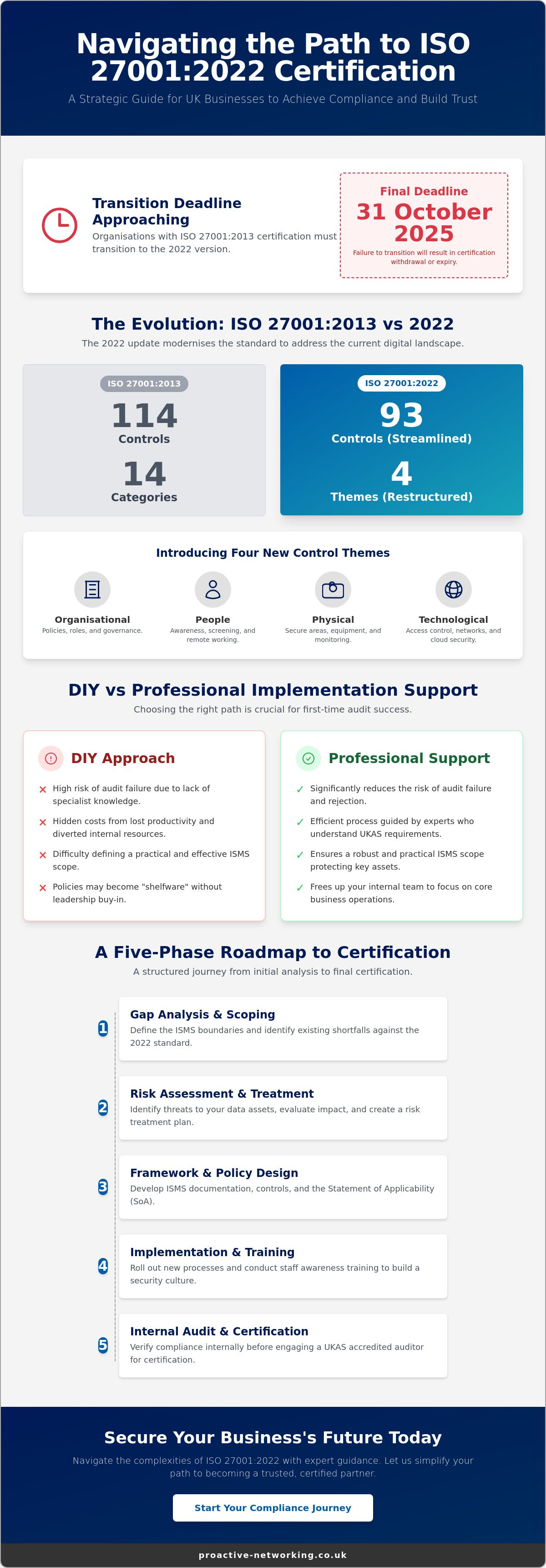
ISO 27001 represents the international gold standard for an Information Security Management System (ISMS). It provides a structured framework to protect sensitive data through a sophisticated combination of people, processes, and technology. For British organisations, adopting ISO/IEC 27001 is no longer just a badge of honour; it's a fundamental requirement for operating within modern, high value supply chains. The standard underwent a significant update in 2022, moving away from the older 2013 version to better address modern threats like cloud security and data leakage. Organisations currently holding the 2013 certification must transition to the 2022 version by 31 October 2025. If they fail to do so, their certifications will be withdrawn or expire.
Seeking professional iso 27001 implementation support is often the most efficient way to manage this transition. It ensures that your internal controls align with the 93 revised controls specified in the new standard. For many firms, the complexity of these requirements makes dedicated iso 27001 implementation support an essential investment rather than an optional luxury. In the UK market, the gold standard for certification is via a UKAS accredited body. Choosing a partner that understands the nuances of UKAS requirements ensures your certification carries the necessary weight during competitive tenders.
The Business Value of Information Security Certification
Securing this certification does more than just tick a compliance box. It establishes a foundation of trust with blue chip clients and government departments who demand rigorous security standards from their partners. By implementing a robust ISMS, you significantly reduce the likelihood of a data breach. This protects your firm from the escalating fines introduced by the Data (Use and Access) Act 2025. Beyond risk mitigation, the framework improves internal efficiency by streamlining how data is handled across the entire organisation.
ISO 27001 vs Cyber Essentials: Choosing the Right Path
Many SMEs start their journey with Cyber Essentials. This is a technical, baseline certification that focuses on five key controls. Whilst it's an excellent starting point, ISO 27001 offers a more comprehensive, management led approach. It looks at the broader security culture and risk management strategy rather than just technical configurations. For businesses in the legal or finance sectors, moving beyond basic accreditation is usually essential to satisfy regulatory bodies and professional indemnity insurers. These two standards aren't mutually exclusive; they work together to create a layered defence that protects your operations from every angle.
The Core Components of a Robust ISMS Framework
Defining the scope of your Information Security Management System (ISMS) is the first critical step in any certification journey. It establishes the boundaries of what you are protecting. If the scope is too narrow, you leave vital assets vulnerable; too broad, and the implementation becomes unmanageable for a small team. Professional iso 27001 implementation support helps you strike this balance, ensuring your framework is both robust and practical. Success isn't just about technical settings. It requires visible commitment from senior leadership to foster a genuine security culture. Without this, policies often become ignored "shelfware" that fails to influence daily behaviour.
The transition to ISO/IEC 27001:2022 introduced a significant reorganisation of Annex A controls. Instead of the previous 14 categories, controls are now grouped into four clear themes: Organisational, People, Physical, and Technological. The total number of controls dropped from 114 to 93, but new additions like threat intelligence and cloud service security reflect the current digital landscape. This structural change requires a complete review of your Statement of Applicability (SoA). The SoA serves as the definitive list of which controls you've implemented and why. It's the first document an auditor will request. You can find more detail on these transitions in BSI's ISO 27001 implementation guide, which remains a vital resource for British firms.
Risk Assessment and Treatment Methodologies
You must identify specific threats to your data assets and evaluate the impact of a potential breach. Once risks are identified, you decide whether to treat, transfer, or accept them. This process culminates in a Risk Treatment Plan. It's a living document that guides your security investments and operational priorities. Many SMEs find that managed compliance support simplifies this technical assessment, turning a complex requirement into a clear action list.
Documentation and Policy Development
Effective documentation should be concise and actionable. Staff need clear policies that they can actually follow in their daily tasks. Overly complex manuals often lead to non-compliance. Organise your records logically so they are easily accessible during your external audit. This proves that your processes are active and effective rather than just theoretical exercises.
DIY vs Professional ISO 27001 Implementation Support
Choosing between a self managed approach and professional iso 27001 implementation support is a pivotal decision for any UK SME. On the surface, the DIY route appears cost effective. However, the hidden reality often involves diverted resources and significant lost productivity. Senior leaders frequently find themselves bogged down in technical documentation, spending hundreds of hours on tasks that would be better handled by specialists. Professional support provides a seasoned expert who translates complex technical jargon into tangible business value, ensuring that your security posture actually supports your commercial objectives rather than hindering them.
Speed to certification is another critical factor. Unsupported projects often stall during the risk assessment phase, leading to months of delays and missed opportunities. In contrast, a structured programme typically achieves certification significantly faster. This efficiency is vital for firms aiming to meet specific tender deadlines or satisfy regulatory requirements. By leveraging external expertise, you mitigate the high risk of audit failure. Failing an audit is both emotionally draining and financially damaging, often requiring a complete restart of the documentation process.
The Role of Managed IT in Security Compliance
Managed IT services are the engine room of a successful ISMS. Proactive monitoring and maintenance don't just keep your systems running; they provide the continuous, real time evidence required for a successful audit. Integrating advanced security controls, such as EDR and XDR, directly into your compliance framework ensures your technical defences are active rather than theoretical. The National Cyber Security Centre (NCSC) provides excellent guidance on these technical foundations. Having a partner who manages both your IT infrastructure and your compliance requirements creates a seamless environment where security is built in by design.
Common Pitfalls in SME Implementation Projects
One of the most frequent mistakes is overcomplicating the ISMS. SMEs often create administrative burdens that are impossible to maintain with a small team, leading to a system that staff eventually ignore. Success requires involving the entire organisation, not just the IT department. Security is a shared responsibility that must influence daily behaviour. Finally, many firms view certification as a one time event. Ignoring the need for continuous improvement after the initial audit is a high risk strategy. A managed IT support and compliance partnership ensures your systems evolve alongside the threat landscape, maintaining your certification status year after year.
A Five Phase Roadmap to ISO 27001:2022 Certification
Achieving certification is a methodical process that requires a structured approach to ensure no critical security gaps are overlooked. For many UK SMEs, the journey from initial interest to final accreditation follows a logical progression that balances technical rigour with operational reality. Leveraging professional iso 27001 implementation support at each stage ensures that your project remains on track and avoids the common delays associated with misinterpreting the standard's requirements. This roadmap breaks the complex journey into five manageable phases.
Phase 1: Gap Analysis and Scoping – This initial stage involves a candid assessment of your current security posture against the 2022 standard. You must define the exact boundaries of your ISMS to ensure all critical data assets are included without overcomplicating the framework.
Phase 2: Risk Assessment and Framework Design – Here, you build the foundation of your ISMS by identifying specific threats and vulnerabilities. You will design the controls and processes necessary to mitigate these risks to an acceptable level.
Phase 3: Implementation of Controls – This is the most active phase, where you deploy the technical and physical security measures identified in your risk treatment plan. It involves updating configurations, training staff, and establishing new operational behaviours.
Phase 4: Internal Audit and Review – Before the official assessment, you must conduct an internal audit. This serves as a vital mock exam to test the effectiveness of your system and identify any non-conformities that require rectification.
Phase 5: External Audit and Certification – The final hurdle involves a two stage assessment by a UKAS accredited certification body. Once successful, you achieve accredited status, which must then be maintained through regular surveillance.
If you are ready to begin this journey, securing expert ISO 27001 implementation support can significantly accelerate your timeline to certification whilst ensuring your framework is built to last.
Preparing for the Stage 1 and Stage 2 Audits
The external audit is split into two distinct parts. Stage 1 is primarily a documentation review where the auditor confirms that your ISMS design meets the standard's requirements. It's a readiness check to ensure you are prepared for the more rigorous Stage 2. During Stage 2, the auditor looks for evidence that you are actually doing what your policies say. They will interview staff and review system logs to verify that controls are effective. A thorough pre-audit check is essential to resolve any minor issues before they become major obstacles to your certification.
Maintaining Compliance and Continuous Improvement
Certification is the beginning of a three year cycle rather than a final destination. You will face annual surveillance audits to ensure your ISMS remains effective and evolves alongside new threats. Regular management reviews are mandatory to confirm that the system continues to support your business objectives. By treating every security incident or near miss as an opportunity to strengthen your defences, you foster a culture of continuous improvement that protects your reputation and your bottom line over the long term.
Securing Your Business Future with Proactive Networking
Proactive Networking Ltd understands that for a UK SME, information security is about more than just technical settings; it is about business continuity and commercial reputation. Our comprehensive iso 27001 implementation support is designed to remove the friction from the certification process, allowing you to focus on your core operations. With over 25 years of experience in the British IT landscape, we've refined a methodology that simplifies complex technical requirements into manageable, strategic actions. We don't just provide a checklist. We act as a protective guardian for your digital assets, ensuring your Information Security Management System (ISMS) is both robust and practical.
Our approach integrates compliance directly with high tier IT support and advanced cyber security measures. By aligning your ISO 27001 goals with active defences like attack surface reduction and email protection, we create a unified security posture. This integration ensures that the evidence required for your annual audits is generated naturally through your daily operations. You won't find yourself scrambling for documentation at the last minute because your systems are designed to be compliant by default. This synergy between managed IT and compliance is what sets Proactive Networking Ltd apart, providing a level of stability that internal teams often struggle to maintain alone.
Compliance for Legal and Financial Services
Solicitors, barristers, and financial firms face unique regulatory pressures that demand a higher level of scrutiny. We specialise in providing sector specific compliance support that addresses the precise data protection requirements of the legal and finance industries. Whether you are managing sensitive client files or high volume financial transactions, we ensure your ISMS provides the necessary resilience. Our team understands the nuances of professional indemnity requirements and the expectations of regulatory bodies, ensuring your certification provides the ultimate peace of mind for your partners and clients alike.
Next Steps: Your Journey to ISO 27001 Starts Here
The path to accredited security begins with a clear understanding of your current position. We invite you to book an initial consultation to assess your existing security posture and identify the most efficient route to certification. From there, we develop a bespoke implementation plan that aligns perfectly with your specific business goals and operational constraints. Don't let the complexity of the 2022 standard hold your business back. Contact Proactive Networking Ltd today for professional guidance on security and compliance, and let us help you secure the future of your organisation.
Strengthening Your Competitive Edge through Robust Security
The transition to the ISO/IEC 27001:2022 standard is a strategic evolution that transforms information security from a back office concern into a powerful commercial asset. Throughout this guide, we've outlined how a structured roadmap and a well defined ISMS scope protect your organisation from the rising costs of data breaches and the complexities of the Data (Use and Access) Act 2025. By moving beyond baseline technical controls, your business demonstrates a level of maturity that is essential for securing high value contracts in the UK's legal and financial sectors.
Securing professional iso 27001 implementation support ensures that your journey is efficient and free from the administrative burdens that often stall DIY projects. Proactive Networking Ltd brings over 25 years of technical expertise to your partnership, acting as a protective guardian for your infrastructure whilst streamlining the certification process. Our managed approach guarantees that your security posture remains resilient long after the final audit is complete.
Ready to transform your compliance into a competitive advantage? Secure your business future with our ISO 27001 implementation support. Proactive Networking Ltd is here to guide you through every phase of the process, ensuring your organisation is prepared for the security challenges of tomorrow.
Frequently Asked Questions
How much does ISO 27001 implementation support typically cost for a UK SME?
The total investment varies depending on your organisation's size, technical complexity, and existing security maturity. Whilst we don't provide fixed pricing here, you should account for both the internal resource time and the external audit fees. In 2026, UKAS accredited auditor day rates typically range from £1,250 to £1,500. Choosing professional support helps you control these costs by avoiding the expensive rework that follows a failed audit attempt.
How long does it take to achieve ISO 27001 certification from start to finish?
Most British SMEs complete the certification process within six to twelve months. This timeframe depends heavily on the clarity of your initial scope and your team's availability to implement new controls. If you're working towards a specific tender deadline, starting the process early is vital. A structured approach ensures that you don't rush the risk assessment phase, which is the foundation of a successful system.
Can a small business achieve ISO 27001 without external support?
It's possible to manage the process internally, but many small firms find the administrative and technical burden overwhelming. Without dedicated iso 27001 implementation support, there's a higher risk of misinterpreting the standard's requirements. This often leads to "over-engineering" the system, creating unmanageable policies that hinder daily operations rather than protecting them. Specialists help you keep the framework lean and effective.
What is the difference between ISO 27001:2013 and ISO 27001:2022?
The 2022 update streamlined the framework by reducing the number of controls from 114 to 93 and organising them into four clear themes. It also introduced 11 new controls specifically designed to address modern threats like cloud security and threat intelligence. Organisations holding the older 2013 version must transition by 31 October 2025 to maintain their accredited status and ensure their defences remain current.
Does ISO 27001 certification guarantee GDPR compliance for my business?
Certification provides a robust foundation for data protection, but it doesn't automatically guarantee full GDPR compliance. Whilst there's significant overlap, you must still address specific legal requirements found in the Data (Use and Access) Act 2025. This includes managing data subject access requests and ensuring your legal basis for processing is correctly documented. ISO 27001 acts as the technical engine that makes these legal obligations easier to manage.
What happens if we fail our ISO 27001 external audit?
Failing an audit usually means the auditor has identified "major non-conformities" that prevent certification. You'll receive a detailed report outlining these gaps, and you won't be awarded the certificate until they're rectified. If you only have "minor non-conformities", you can often still achieve certification on the condition that you provide a documented action plan to resolve the issues before your next surveillance visit.
How often do we need to renew our ISO 27001 certification?
The certification follows a three year cycle to ensure continuous improvement. You'll undergo annual surveillance audits to verify that your ISMS is still functioning correctly and evolving with your business. In the third year, a full recertification audit is required to renew the certificate for another cycle. This rhythm ensures that security remains a board level priority rather than a one time project.
Is ISO 27001 mandatory for all UK businesses in the finance sector?
It isn't a universal legal requirement for every firm, but it's often a de facto standard for doing business in the UK finance sector. Most major banks and financial institutions require their partners to hold the certification as part of their supply chain risk management. Providing iso 27001 implementation support for highly regulated firms is common because it provides the necessary evidence of operational resilience that regulators and insurers expect.


Comments