


How to Create a Business Continuity Plan for SMEs in 2026
- Simon Raine
- 2 days ago
- 12 min read
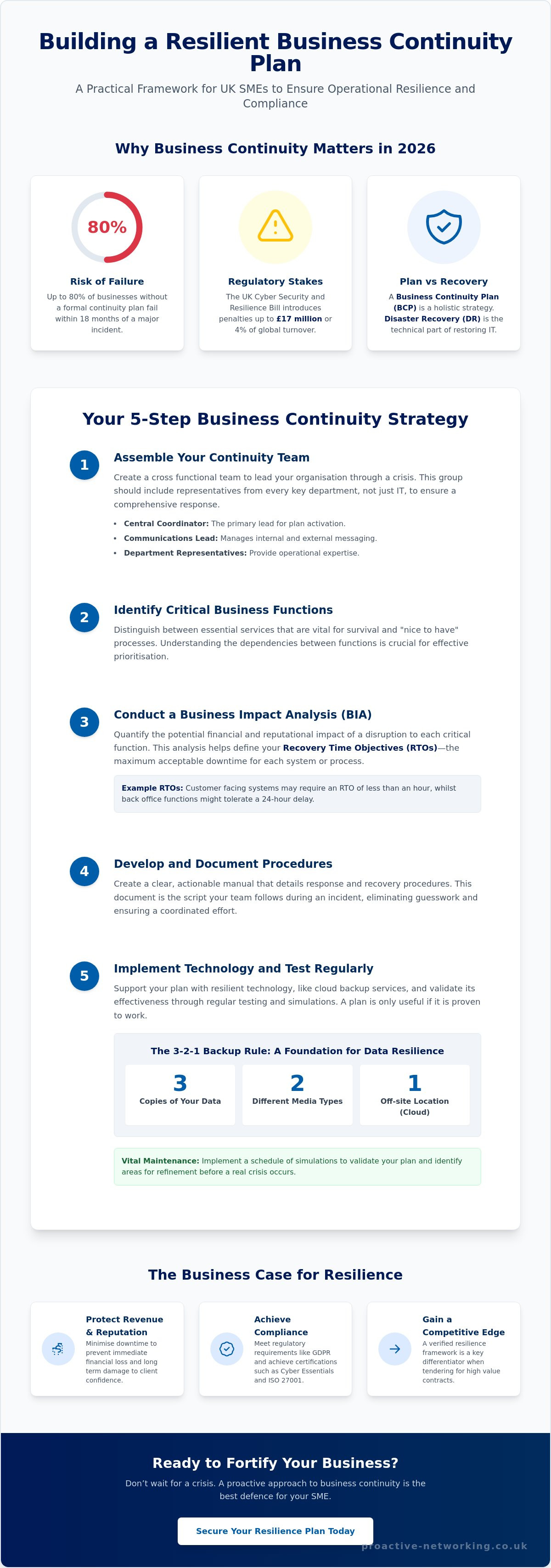
Did you know that up to 80% of businesses without formal continuity arrangements fail within just 18 months of a major incident? In 2026, the margin for error has narrowed as the UK's Cyber Security and Resilience Bill introduces stricter oversight and the potential for significant penalties. Establishing a robust business continuity plan for smes is no longer a secondary task; it's a fundamental requirement for any organisation that values its longevity and reputation.
You likely recognise that a simple data backup isn't enough to keep your doors open during a sophisticated cyber attack or a system outage. It's common to feel a sense of unease regarding the distinction between basic recovery and true operational resilience, especially with the added pressure of GDPR and ISO 27001 compliance. You need a strategy that offers more than just survival; you need a way to maintain service levels whilst protecting your most critical assets.
This guide provides a practical, step-by-step framework for building a resilient business continuity plan that protects your SME from downtime and data loss. We'll outline a clear roadmap to help you achieve digital resilience and compliance with standards like Cyber Essentials, ensuring your business remains steady even when faced with the unexpected.
Key Takeaways
Learn how to distinguish between basic data backups and a comprehensive business continuity plan for smes to ensure your organisation remains operational during any disruption.
Discover the essential steps to assemble a continuity team and define the specific roles required to lead your business through a period of crisis.
Gain clarity on how to conduct a Business Impact Analysis to categorise your activities and prioritise the protection of your most critical functions.
Understand the strategic importance of the 3 2 1 backup rule and how cloud services provide a reliable foundation for modern data resilience.
Learn why regular testing is vital and how to implement a schedule of simulations that validates your plan and identifies areas for refinement.
Table of Contents
Understanding Business Continuity Planning for UK SMEs
A Business Continuity Planning framework is a proactive strategy designed to keep your organisation functional during a crisis. Many leaders mistakenly believe that having a data backup is sufficient; however, whilst backups preserve your information, they don't define how your team will operate or how you'll maintain client trust during a system failure. A robust business continuity plan for smes acts as a protective shield, ensuring your services remain available even when technical or physical disruptions occur. It's a structured approach that prioritises your most vital operations so that you can navigate a crisis without losing control.
The threat landscape in 2026 has made this level of preparation mandatory. SMEs are now frequent targets for cyber criminals who view them as vulnerable entry points into larger supply chains. Beyond the immediate threat of data loss, the UK's Cyber Security and Resilience Bill now mandates a higher standard of digital hygiene. With potential penalties for serious breaches reaching up to £17 million, or 4% of global turnover, establishing a formal plan is a critical step toward regulatory adherence. Statistics suggest that up to 80% of businesses without such arrangements fail within 18 months of a major incident, making resilience a matter of survival.
BCP vs Disaster Recovery: Knowing the Difference
Disaster Recovery is a technical subset of your overall strategy. It focuses specifically on the restoration of IT systems, servers, and data after a failure. In contrast, BCP is the broader umbrella that encompasses people, physical locations, and essential communication protocols. For a recovery to be truly seamless, these two functions must be integrated. Your technical restoration is only effective if your staff understand their assigned roles and your manual processes are ready to bridge the gap until systems are fully restored.
The Business Case for Resilience in 2026
The financial impact of downtime often extends far beyond lost immediate revenue. It erodes client confidence and can lead to long term reputational damage that is incredibly difficult to repair. By implementing a structured business continuity plan for smes, you can often secure more favourable insurance premiums and satisfy the rigorous requirements of your stakeholders. Additionally, having a verified resilience framework, such as Cyber Essentials or ISO 27001, provides a distinct competitive advantage. It demonstrates a high tier standard of care that can be the deciding factor when you are tendering for high value contracts with larger, risk averse organisations.
A 5-Step Guide to Building Your Business Continuity Strategy
Developing a business continuity plan for smes is a methodical process that transforms abstract fears into actionable protocols. This strategy ensures that when a disruption occurs, your team doesn't waste time debating the next move; they simply execute a pre-verified script. Achieving true SME resilience involves five distinct stages that align your operational needs with your technical capabilities.
The first stage is assembling your continuity team. This group should include representatives from every key department, not just the IT staff. Assigning clear roles, such as a central coordinator and a communications lead, ensures accountability during a crisis. Once the team is in place, the second step is identifying critical business functions and their dependencies. This involves distinguishing between "nice to have" processes and those essential for survival. The third step is the Business Impact Analysis (BIA), which quantifies the financial and reputational risks associated with various disruptions. Following this, you must develop and document your response and recovery procedures, creating a clear manual for staff to follow. Finally, you implement the necessary technology, such as redundant cloud infrastructure, to support these procedures.
Defining Recovery Time Objectives (RTO)
The Recovery Time Objective (RTO) is perhaps the most significant metric in your strategy. It defines the maximum duration your organisation can remain offline before the impact becomes catastrophic. Setting these targets requires a nuanced understanding of each department's needs. Whilst some back office functions might tolerate a 24 hour delay, customer facing systems often require an RTO of less than an hour. Balancing the investment required for rapid recovery against the potential cost of downtime is a strategic decision that requires careful consideration. If you need assistance determining these technical requirements, expert IT Support can provide the necessary clarity.
Mapping Dependencies and Supply Chains
No SME operates in total isolation. Your plan must account for the third party software, cloud providers, and physical suppliers that keep your business running. Identifying "single points of failure" is vital. If your entire operation relies on one specific cloud platform or a single broadband line, a failure at that point could be devastating. Effective mapping involves organising alternative suppliers and redundant systems in advance. This proactive approach ensures that a crisis at a vendor doesn't automatically become a crisis for your clients. By accounting for these external links, you build a more durable framework that withstands broader market shocks.
Conducting a Business Impact Analysis (BIA) for Critical Functions
A Business Impact Analysis (BIA) serves as the analytical engine of your business continuity plan for smes. Its primary purpose is to identify the precise consequences of a specific function stopping, allowing you to move beyond general assumptions. By evaluating the ripple effects of a disruption, you can determine which activities are the lifeblood of your organisation. This process involves categorising every business activity into three tiers: Critical, Essential and Support. Critical functions are those that must be restored almost immediately to prevent total operational collapse. Essential tasks are important but can be delayed for several hours without permanent damage. Support activities are those that can remain offline for days whilst you focus on recovery.
Assigning a financial and operational cost to these scenarios is vital. You should consider direct revenue loss alongside indirect costs like regulatory fines or the erosion of client trust. This data is indispensable when you are prioritising investments in multi-layered cyber security for smes, as it directs your capital toward the vulnerabilities that pose the greatest threat to your solvency.
Quantifying Operational Risks
A rigorous BIA requires you to assess various disruption scenarios, including data breaches, hardware failures and prolonged power outages. We recommend using a simple 1-5 scoring system to rank both the probability of an event and its potential impact. A score of 5 indicates a catastrophic result that could end the business, whilst a 1 suggests a minor inconvenience. By identifying exactly which functions are mission critical, a BIA ensures that your budget is allocated precisely to high impact areas rather than being diluted across non-essential systems.
Documenting Resource Requirements
Once you understand the "what", you must document the "how". This involves determining the minimum staff levels, specific hardware and data sets required to maintain your critical tier functions. You should identify your "vital records", which are documents such as legal contracts, financial ledgers and client databases that must be accessible within minutes of a crisis. Ensuring these requirements are documented helps your organisation align with cyber security compliance services UK, providing a structured path toward professional accreditation. This level of detail transforms your business continuity plan for smes from a theoretical document into a functional toolkit for survival.
Implementing Cloud Backup Services as a Continuity Foundation
In 2026, the bedrock of any business continuity plan for smes is a sophisticated cloud infrastructure. It's no longer sufficient to rely on physical tapes or external hard drives that are subject to environmental damage or simple human forgetfulness. Modern cloud backup services for smes provide a layer of protection that is both invisible and infallible. By adhering to the 3-2-1 backup rule, you maintain three separate copies of your data on two different types of media, with one copy stored securely off-site in the cloud. This redundancy ensures that even a total site disaster doesn't result in permanent data loss.
Automation is the primary advantage of cloud-native solutions. It removes the risk of an employee forgetting to plug in a drive or failing to verify a backup's integrity. Integrating these services with managed it support ensures that your recovery environment is monitored around the clock, providing peace of mind that your data is always current. If you require a tailored resilience strategy that incorporates these high-tier standards, you can explore our professional Business Continuity options.
Setting Up Automated Cloud Workflows
Choosing between file-level and image-level backups is a strategic decision. File-level is efficient for specific documents, whilst image-level captures your entire system state, including operating systems and configurations. Your backup frequency must align with your Recovery Point Objective (RPO), which is the maximum amount of data you're willing to lose between backups. For high-traffic databases, this might mean synchronisation every few minutes. Security is paramount; therefore, ensure your provider encrypts data whilst it's in transit and amongst the cloud servers.
Instant Recovery and Virtualisation
The true power of the cloud lies in virtualisation. During a crisis, you can "spin up" virtual versions of your servers in the cloud, allowing staff to work remotely whilst your physical office is restored. This capability reduces your Recovery Time Objective (RTO) from days to mere hours, maintaining your professional reputation during an outage. To protect against modern threats, immutable backups are essential. These recovery points are write-protected and cannot be altered or deleted by malicious software, which effectively prevents ransomware from destroying your ability to restore your systems.
Testing and Maintaining Your Resilience Framework
A business continuity plan for smes that hasn't been rigorously tested is little more than a collection of assumptions. Whilst documenting your procedures is a vital first step, the true value of your resilience framework is only realised when it's subjected to the pressures of a simulated crisis. Testing ensures that your staff are familiar with their roles and that your technical recovery systems perform as expected under stress. Without regular validation, you risk discovering critical flaws only when a real disruption occurs. At that point, the cost of failure is absolute.
Your testing schedule should be varied and progressive. It should move from simple walkthroughs to complex simulations. A walkthrough involves a group review of the plan to identify obvious errors, such as outdated contact information or changes in software dependencies. More advanced testing includes full simulations where specific systems are taken offline to verify that recovery procedures are functional. These exercises allow you to refine your strategy based on objective data rather than guesswork. Testing is the only way to ensure your organisation remains agile as it grows.
Conducting Tabletop Exercises
Tabletop exercises are scenario based workshops where key staff members gather to discuss their response to a hypothetical threat. You might simulate a ransomware attack or a prolonged power failure. These sessions are invaluable for identifying gaps in communication and decision making that aren't always apparent in a written document. By working through a crisis in a controlled environment, you can observe how information flows amongst your team. You can see exactly where bottlenecks occur. Following the exercise, it's essential to create a lessons learned report. This document captures every identified weakness and provides a structured list of updates for your BCP. It ensures your resilience posture is constantly evolving.
The Role of Professional IT Partners
Maintaining a sophisticated business continuity plan for smes requires ongoing technical oversight. This is something many internal teams find challenging to sustain alongside daily operations. Proactive Networking Ltd facilitates professional testing and monitoring to ensure your underlying infrastructure management remains perfectly aligned with your continuity goals. We provide the strategic foresight needed to keep your recovery protocols relevant against emerging threats. Whether it's AI powered phishing or new regulatory requirements, we act as a protective guardian for your operations. To ensure your organisation is truly prepared for the unexpected, speak to our experts about your business continuity requirements today.
Securing Your Operational Future
Establishing a robust business continuity plan for smes is no longer a luxury for the few; it's a fundamental pillar of modern operational excellence. By conducting a detailed Business Impact Analysis and leveraging automated cloud workflows, you transform your organisation from a vulnerable target into a resilient leader. True stability comes from the knowledge that your systems are monitored and your recovery protocols have been verified through rigorous testing, ensuring you remain functional regardless of external pressures.
Proactive Networking Ltd brings over 25 years of UK IT expertise to your side. As Cyber Essentials and ISO 27001 specialists, we provide the sophisticated monitoring required to identify and prevent downtime before it can impact your reputation. We simplify the complex technical landscape, allowing you to focus on growth whilst we act as the protective guardian of your digital assets. Don't leave your organisation's survival to chance in an increasingly volatile environment.
Secure your business future with a professional continuity audit and take the first step toward total operational peace of mind. Your journey toward a more resilient future starts with a single, strategic decision today.
Frequently Asked Questions
What are the four phases of a business continuity plan?
The four phases of a business continuity plan for smes typically consist of analysis, design, implementation, and maintenance. During the analysis phase, you identify potential risks and operational dependencies. The design phase involves crafting specific recovery strategies, whilst implementation focuses on deploying the necessary technology and staff protocols. Finally, the maintenance phase ensures the plan is regularly tested and updated to remain effective against evolving threats.
How much does a business continuity plan cost for a UK SME?
The cost of developing a business continuity plan for smes varies based on the complexity of your operations and your specific certification goals, such as ISO 22301. Whilst a basic internal document primarily requires staff time, a professional resilience framework involves investments in redundant cloud infrastructure and expert consultancy. Many organisations find that the initial expenditure is offset by reduced insurance premiums and the ability to satisfy rigorous supply chain requirements.
Is a business continuity plan a legal requirement for UK businesses?
Whilst not a universal legal requirement for every small business, a business continuity plan is mandatory for organisations in regulated sectors such as finance, legal services, and healthcare. Additionally, the UK's Cyber Security and Resilience Bill and GDPR standards effectively necessitate recovery protocols for protecting personal data. Failing to maintain a formal plan can lead to significant regulatory penalties and the loss of professional accreditations required for high tier contracts.
How often should an SME update its business continuity plan?
You should review and update your business continuity plan at least once a year or whenever a significant change occurs within your organisation. This includes moving to a new office, adopting different software, or experiencing a shift in your primary supply chain. Regular updates ensure that contact lists remain accurate and that your technical recovery steps align with your current IT infrastructure, preventing the plan from becoming obsolete.
Can cloud backup services for smes replace a full business continuity plan?
No, cloud backup services for smes are a vital technical component but they cannot replace a comprehensive business continuity plan. Backups focus exclusively on data preservation, whilst a BCP addresses the people, physical locations, and communication strategies required to keep your business running. You need a formal plan to define how your team will operate and how you will manage client expectations whilst your data is being restored.
What is the difference between RTO and RPO in business continuity?
Recovery Time Objective (RTO) refers to the maximum duration your organisation can survive offline before the impact becomes catastrophic. In contrast, Recovery Point Objective (RPO) defines the maximum amount of data you can afford to lose, measured in time. For example, an RTO of four hours means you must be back online within that window, whilst an RPO of one hour means your backups must never be more than an hour old.
How do I involve my employees in business continuity planning?
Involving employees begins with assigning clear roles within your continuity team and conducting regular training sessions to build familiarity with recovery protocols. You should encourage staff to participate in tabletop exercises, as their frontline knowledge often reveals operational dependencies that management might overlook. By fostering a culture of resilience, you ensure that every team member understands their specific responsibilities and can act with confidence if a real disruption occurs.
What should be included in an SME emergency communication plan?
Your emergency communication plan must include a comprehensive contact list for employees, clients, and key suppliers, alongside pre-written message templates for various crisis scenarios. It should specify which primary and secondary channels you will use, such as email, SMS, or dedicated apps, to ensure information reaches the right people. This structured approach maintains your professional reputation by ensuring that your messaging remains calm, consistent, and accurate during a period of instability.


Comments