


Cyber Security for Schools UK: A Professional Guide to DfE Compliance in 2026
- Simon Raine
- 2 days ago
- 12 min read
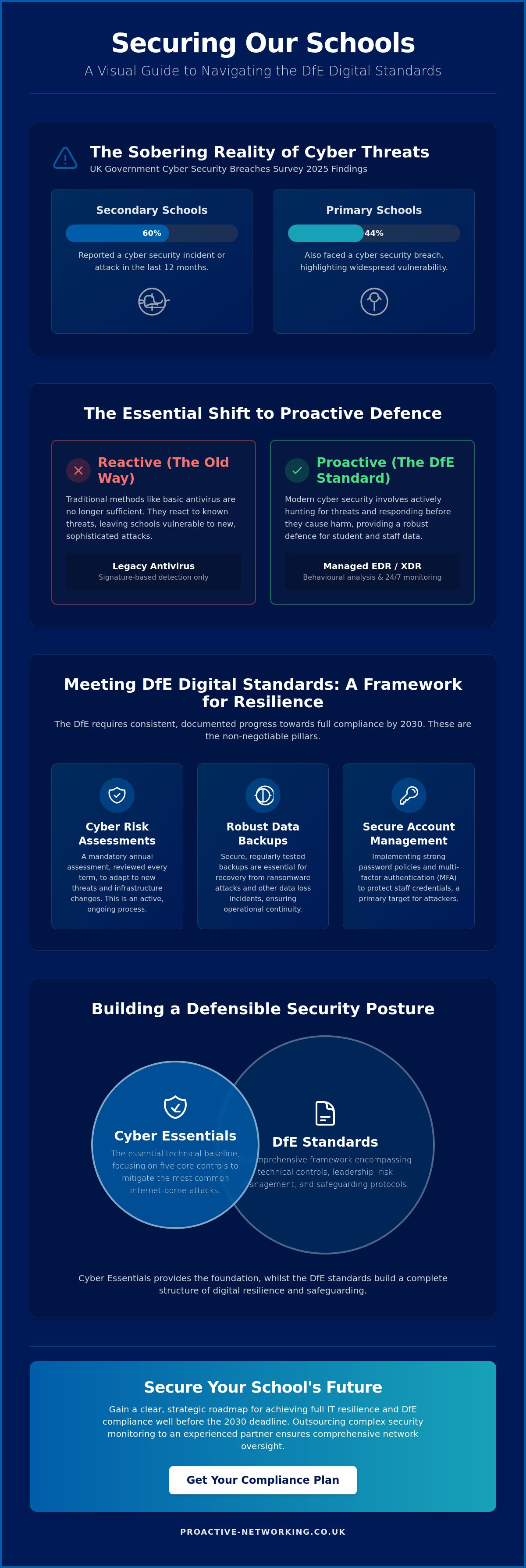
60% of secondary schools and 44% of primary schools in the UK reported a cyber security incident in 2025, according to the Government's Cyber Security Breaches Survey. For school leaders, these figures represent more than just technical failures; they are a direct threat to the safety and privacy of students. You likely feel the pressure of meeting the complex DfE 2030 standards whilst managing limited budgets and a packed academic calendar. It's a challenging balance to strike, especially when the digital landscape changes so rapidly.
This professional guide clarifies the path forward, helping you master the complexities of the DfE digital standards to ensure your institution remains a secure environment for staff and students. By adopting a safeguarding first approach to cyber security for schools UK, you can transform technical compliance into long term IT resilience. We will examine the April 2026 updates to security and filtering standards, explain the new Wi-Fi 7 requirements and provide a clear roadmap for the 2030 compliance deadline to ensure your school remains protected and prepared.
Key Takeaways
Understand how to align your school with the latest DfE digital standards to ensure safeguarding protocols extend effectively into the digital realm.
Discover why shifting from reactive antivirus to proactive EDR and Managed XDR is essential for modern cyber security for schools UK.
Learn the critical relationship between DfE compliance and Cyber Essentials certification to build a sophisticated and defensible security posture.
Identify the cost efficiencies and technical benefits of outsourcing complex security monitoring to experienced partners who provide comprehensive network oversight.
Gain a clear, strategic roadmap for achieving full IT resilience and DfE compliance well before the 2030 deadline.
Table of Contents
Navigating the Cyber Security Landscape for UK Schools in 2026
The education sector has undergone a profound digital transformation over the last five years. Whilst cloud adoption and hybrid learning have enriched the curriculum, they have also created new vulnerabilities that sophisticated threat actors are eager to exploit. Schools are no longer peripheral targets; they are often viewed as "soft targets" due to the immense volume of sensitive safeguarding data they hold and the traditionally limited resources allocated to IT management. This combination of high value data and perceived lower defences makes the sector particularly attractive to ransomware groups and phishing campaigns.
A breach in 2026 carries consequences that extend far beyond simple data loss. It can paralyse a school's operations, leading to days of lost learning and significant financial strain. The School Business Manager now acts as a vital orchestrator in this digital defence strategy, bridging the gap between technical requirements and budgetary constraints. Effective cyber security for schools UK requires a shift in mindset, treating digital protection as a direct extension of the school's safeguarding duty. It's about protecting people and their futures, not just securing servers and networks.
The State of School Cyber Security in 2026
The Government's Cyber Security Breaches Survey 2025 highlights a sobering reality: 60% of secondary schools and 44% of primary schools reported a cyber security incident within a single year. These figures reflect a shift from basic malware to sophisticated identity based attacks. As schools adopt Wi-Fi 7 and expand their cloud footprints, the attack surface grows. Attackers now focus on compromising staff credentials to gain access to Management Information Systems (MIS). Recovery costs for a typical secondary school can be devastating, often involving weeks of forensic investigation and system restoration. This evolution makes robust cyber security for schools UK a matter of institutional survival rather than just an IT concern.
Regulatory Pressures and Governing Body Expectations
Ofsted and other governing bodies now place a significant emphasis on digital resilience as a core component of safeguarding. Compliance with the Cyber Essentials scheme is increasingly viewed as the baseline for technical control and is already a requirement for colleges under ESFA agreements. Under the Data Protection Act 2018 and GDPR, educational trusts face rigorous legal obligations to protect student data. Governors must recognise that "doing nothing" is a high risk strategy that could lead to legal action or severe reputational damage. Proactive management is the only way to meet these expectations whilst ensuring a secure environment for every pupil. The DfE's 2030 deadline for digital standards compliance provides a clear timeline, but the threats schools face today demand more immediate action.
Meeting the DfE Digital and Technology Standards: A Framework for Resilience
The Department for Education has provided a clear structure for institutional safety. Meeting the DfE Digital and Technology Standards is no longer an optional exercise for those managing cyber security for schools UK. These guidelines, last updated on 17 April 2026, serve as a comprehensive framework for digital leadership and technical defence. Whilst the final deadline for full compliance is 2030, the DfE expects schools to demonstrate consistent, documented progress today.
Effective resilience begins with three non negotiable pillars: risk assessments, data backups, and account security. A formal cyber risk assessment shouldn't be a static document tucked away in a folder. The DfE now requires an annual assessment that's reviewed every term to account for new threats or changes in infrastructure. This keeps your leadership team agile. It's about active protection. By maintaining this rhythm, you ensure that your security posture evolves alongside the sophisticated tactics used by modern attackers.
Cyber Essentials vs. DfE Standards: Which Do You Need?
Cyber Essentials serves as the essential technical baseline for all UK educational institutions. It focuses on five core controls that mitigate the majority of common internet borne attacks. In contrast, the DfE standards go further by integrating these technical controls into broader school governance and safeguarding strategies. For Multi Academy Trusts (MATs), achieving Cyber Essentials Plus provides an additional layer of assurance through independent verification. This higher standard demonstrates a sophisticated commitment to security that reassures parents and regulators alike. If you need help navigating these requirements, Proactive Networking Ltd offers expert guidance on Cyber Essentials and GDPR compliance to simplify the process.
The 2030 Roadmap: What Schools Must Achieve Now
Progressing towards the 2030 deadline requires a methodical approach starting in 2026. One of the most impactful immediate actions is implementing multi factor authentication (MFA) across all staff, governor, and privileged accounts. This single step significantly reduces the risk of identity based breaches. Additionally, schools must establish a robust backup and disaster recovery plan. It's not enough to simply store data; the DfE standards mandate that these backups are tested at least once a year to ensure they actually work during a crisis. This verified readiness is what separates a minor disruption from a catastrophic data loss event.
Why Cyber Security is a Critical Safeguarding Priority
Cyber security is often viewed through a technical lens, yet in an educational setting, it is fundamentally a human issue. It is the digital extension of your physical safeguarding policy. When we discuss cyber security for schools UK, we aren't just talking about firewalls or encrypted servers; we are talking about the safety of children. A breach that exposes the home addresses of vulnerable pupils or the medical records of staff members isn't a mere IT failure. It's a safeguarding crisis that requires immediate, senior level attention.
Beyond the immediate theft of data, a successful ransomware attack can force a school to close its doors for days or even weeks. For many students, the school building represents their primary safe space. Losing access to this environment can disrupt vital support networks and increase the risk to children who rely on the school for more than just education. Protecting the digital infrastructure ensures that these physical doors stay open and that the school remains a dependable sanctuary for the community.
Protecting Sensitive Student and Staff Data
Management Information Systems (MIS) like SIMS or Arbor contain a wealth of sensitive data, including child protection reports, behavioural records, and medical histories. If this information falls into the wrong hands, the consequences are severe. Compromised records can be used for identity theft or, more disturbingly, for targeted grooming by individuals who exploit known vulnerabilities in a child's background. The psychological impact on the school community is profound and long lasting. Trust is the foundation of any educational institution. Once student privacy is compromised, that trust is incredibly difficult to rebuild, often leaving staff and parents feeling exposed and anxious.
The Role of Filtering and Monitoring in Safeguarding
Effective cyber security for schools UK must align seamlessly with the "Keeping Children Safe in Education" (KCSiE) guidance. Modern filtering and monitoring solutions do more than just block harmful websites; they provide an essential layer of oversight. These systems provide proactive threat detection that identifies patterns of behaviour indicating a child may be at risk of radicalisation, self-harm, or exploitation. This technical layer supports a broader "culture of vigilance" amongst all stakeholders, from the IT team to the classroom teacher. By integrating these systems, leadership teams ensure that digital tools remain assets for learning rather than gateways to potential harm.
Implementing a Proactive Cyber Defence: A Step-by-Step Approach
Reacting to a breach after it has occurred is no longer a viable strategy for educational institutions. A truly resilient posture for cyber security for schools UK requires a shift from passive "hope for the best" antivirus software to proactive, 24/7 monitoring. This transition involves reducing your attack surface and ensuring that every device, user, and email account is shielded by a sophisticated layer of defence. By closing the gaps in your network today, you prevent the technical disruptions that compromise learning and safeguarding tomorrow.
Turning the "human factor" into a line of defence is equally critical. Staff awareness training should move beyond annual tick box exercises to become part of the school's ongoing culture. When teachers and administrators are trained to recognise sophisticated phishing attempts, they become active participants in your digital safety. This combined approach of high level technical controls and a vigilant workforce creates a formidable barrier against modern threats.
Step 1: Conduct a Comprehensive Vulnerability Audit
Effective security begins with a clear understanding of your current environment. This starts by identifying "shadow IT", which includes unauthorised devices or software applications used by staff and students without the IT team's knowledge. We also recommend a rigorous review of your email security protocols, including Managed Domain Hosting with DMARC, SPF and DKIM security to prevent spoofing. Finally, you must enforce the "principle of least privilege", ensuring that users only have access to the specific data and systems required for their roles, thereby limiting the potential damage of a compromised account.
Step 2: Deploy Advanced Threat Protection (EDR and XDR)
Traditional antivirus is often insufficient against modern zero day exploits that have no known signature. This is why we advocate for Endpoint Detection and Response (EDR) and Extended Detection and Response (XDR). These technologies don't just block known threats; they monitor for suspicious behaviour and isolate infected devices before a threat can spread across the entire network. For complete peace of mind, a Security Operations Centre (SOC) provides the constant oversight needed to manage these systems effectively. Secure your infrastructure today with our comprehensive cyber security and EDR solutions.
Step 3: Establish an Incident Response and Recovery Plan
The first four hours of a suspected attack are the most critical. Your school must have a documented plan that outlines immediate technical actions and communication strategies for parents, the DfE and the ICO. Business continuity relies on clearly defined Recovery Time Objectives (RTO) and Recovery Point Objectives (RPO). By testing these recovery plans annually, you ensure that your local and cloud data backups are not just stored, but are fully functional and ready to restore your operations with minimal downtime.
Strategic IT Partnerships: Securing Your School’s Future with Proactive Networking Ltd
Managing cyber security for schools UK in house often places an unsustainable burden on limited IT budgets and internal staff. Outsourcing these complex requirements to a dedicated partner is frequently more cost effective than attempting to build a specialist security team from scratch. It allows school leaders to access high tier expertise without the overhead of recruiting and training analysts. Proactive Networking Ltd brings 25 years of experience in securing complex UK infrastructures, providing a steady hand to guide your institution through the evolving threat landscape. We simplify the path to DfE compliance, ensuring your digital environment is a robust foundation for learning.
Our services are specifically designed to meet the unique needs of the education sector. From managing your Microsoft 365 licensing to providing expert ISO 27001 guidance, we ensure every aspect of your digital estate is optimised and secure. We act as a protective guardian, allowing your senior leadership team to focus on educational outcomes rather than technical vulnerabilities. By aligning your IT strategy with professional standards, we help you build a resilient infrastructure that stands the test of time. This strategic alignment ensures that every pound spent on technology contributes directly to a safer and more reliable learning environment.
Managed IT Support Designed for the Education Sector
We take a rigorous approach to attack surface reduction, ensuring that every potential entry point into your school network is identified and shielded. This includes robust email, user, and sign in protection to thwart phishing attempts before they reach staff inboxes. We also ensure your connectivity is dependable by managing resilient broadband and backup lines. Every school we support benefits from managed domain hosting with DMARC, SPF, and DKIM security as standard, providing a sophisticated layer of defence against domain spoofing and identity theft. This comprehensive oversight ensures that your basic infrastructure is inherently secure.
Your Partner in Compliance and Continuity
Whether you are a standalone primary school or a large Multi Academy Trust (MAT), we provide the strategic oversight needed to achieve and maintain critical certifications. Our team offers expert consultancy on GDPR and sector specific regulatory adherence, ensuring your data handling practices meet the highest standards. We guide you through the Cyber Essentials and Cyber Essentials Plus processes, providing the technical evidence and governance support required for success. This proactive approach ensures your school remains compliant, secure, and ready for any future regulatory changes. Ensure your school is protected and compliant today.
Securing the Future of Digital Learning
The transition from legacy antivirus systems to advanced technical shields is no longer a mere recommendation; it's a fundamental requirement for institutional safety. By aligning your digital strategy with the latest DfE standards, you protect more than just data. You ensure the continuity of education and the physical safety of your pupils. Effective cyber security for schools UK requires a sophisticated balance of governance and proactive monitoring that evolves as quickly as the threats themselves.
Proactive Networking brings over 25 years of UK IT experience to every partnership. As specialists in Cyber Essentials and ISO 27001 compliance, we provide the strategic guidance and technical protection, including proactive EDR and XDR, that educational trusts need to remain resilient. We simplify the complexities of compliance so you can focus on providing a world class education in a secure environment. Take the first step towards a more secure and compliant future for your institution today.
Request a Cyber Security Audit for Your School
Your school's digital resilience is within reach, and we're here to help you achieve it with confidence.
Frequently Asked Questions
What are the DfE cyber security standards for schools?
The DfE standards comprise seven specific requirements updated in April 2026 to protect educational digital infrastructure. These include performing regular risk assessments, maintaining a cyber awareness plan, and ensuring all technology is secured with anti malware and firewalls. Additionally, schools must manage user accounts strictly, keep software licensed and updated, maintain a tested data backup plan, and follow established reporting protocols for attacks.
Is Cyber Essentials mandatory for UK schools in 2026?
Cyber Essentials is currently mandatory for colleges under their ESFA funding agreements, whilst for schools, it remains the recommended technical baseline. Even if not yet a legal requirement for all, the DfE expects schools to meet these standards as part of the 2030 roadmap. Achieving this certification is a vital step in establishing robust cyber security for schools UK and protecting student data.
How much does it cost to secure a school network?
The cost varies significantly based on the size of the institution and the complexity of the existing network. Schools should budget for core components such as multi factor authentication, proactive monitoring systems, and resilient backup solutions. Rather than looking for a fixed price, leadership teams should focus on a phased investment strategy that aligns with DfE digital standards and addresses the most critical vulnerabilities first.
What should a school do if they suffer a ransomware attack?
Immediate isolation of affected devices is the first priority to contain the threat. Following this, the school must enact its incident response plan and report the incident to 'Report Fraud' and the DfE. If personal data is compromised, you must notify the Information Commissioner's Office (ICO) within 72 hours under GDPR. Proactive Networking Ltd can assist in developing these response protocols to ensure business continuity.
How often should school staff receive cyber security training?
Staff training should be an ongoing engagement rather than a single annual event to remain effective. The DfE requires a documented awareness plan that evolves alongside emerging threats. Regular updates help your team recognise the latest identity based attacks and phishing campaigns. This consistent approach ensures that every member of staff remains a vigilant part of the school's digital defence strategy.
Does our school need a dedicated Cyber Security Officer?
Most schools don't require a dedicated full time officer, but they must have clearly defined digital leadership. The DfE standards emphasise that cyber security for schools UK is a shared responsibility between senior leaders, governors, and IT support teams. Many schools choose to work with a strategic partner like Proactive Networking Ltd to provide the high level technical oversight and monitoring required.
What is the difference between filtering/monitoring and cyber security?
Filtering and monitoring are safeguarding tools designed to protect students from harmful online content and track digital behaviour. Cyber security is the technical shield that protects the entire school infrastructure from external threats like ransomware and unauthorised data access. Whilst they serve different primary functions, they must work together as part of a comprehensive safeguarding and digital safety policy.
How does ISO 27001 benefit a Multi Academy Trust?
ISO 27001 provides a standardised framework for managing information security across multiple sites, ensuring consistency throughout a Multi Academy Trust. It demonstrates a sophisticated commitment to data protection that reassures stakeholders and regulatory bodies. By adopting this international standard, a trust can simplify its governance and ensure that every school under its care meets the same high tier security requirements.


Comments