


Managed IT Support Pricing UK: The 2026 Professional Cost Guide
- Simon Raine
- May 28
- 12 min read
In 2026, the cost of managed IT support is no longer a simple line item for fixing broken computers; it's the price of your business's immunity against a £17.5 million regulatory fine. Most business leaders feel a sense of dread when reviewing managed IT support pricing UK, fearing that a low headline figure hides a labyrinth of out of scope charges and rigid contracts. You're right to be cautious. The recent implementation of the Data (Use and Access) Act 2025 has fundamentally changed what standard support must include to keep your organisation legal and secure.
We understand that managing these technical and financial complexities can feel overwhelming. This guide provides a definitive benchmark for current market rates, helping you identify true value whilst ensuring you aren't overpaying for redundant services or under investing in critical security. We will break down the shift from reactive fixes to proactive protection and provide a clear framework to compare provider quotes with absolute confidence.
Key Takeaways
Establish a predictable financial framework by moving from ad hoc technical fixes to the industry standard per user monthly investment model.
Navigate the 2026 market benchmarks for managed IT support pricing UK to distinguish between comprehensive protection and high risk budget alternatives.
Evaluate the critical role of advanced security layers like EDR and XDR in driving service value and ensuring regulatory compliance.
Utilise a professional checklist to compare MSP quotes fairly whilst identifying hidden onboarding fees and potential scope creep.
Understand how a proactive guardian approach minimises operational downtime and simplifies the management of complex technical environments.
Table of Contents
Understanding Managed IT Support Pricing Models in 2026
Viewing IT costs as a series of emergency invoices is a strategic error. Instead, sophisticated organisations treat their technology budget as a predictable monthly investment. This shift allows for a stable financial roadmap whilst ensuring that infrastructure remains resilient and compliant. When evaluating Managed IT Support Models, the goal is to understand the Total Cost of Ownership (TCO). This includes the monthly fee and the potential financial impact of security breaches, data loss or system failures.
Traditional "break-fix" models often appear cheaper on paper. They carry significant hidden costs. Every minute of downtime represents lost productivity and potential reputational damage. Proactive managed IT support pricing UK accounts for the work done behind the scenes to prevent these failures before they occur. By investing in continuous monitoring and maintenance, businesses avoid the catastrophic spikes in expenditure associated with emergency repairs. This approach functions as a protective guardian for your operations, ensuring that technical challenges are identified and resolved before they impact your bottom line.
The Per-User vs. Per-Device Debate
The per-user model has become the standard for UK SMEs in 2026. It supports the modern "work from anywhere" environment where a single employee might use a laptop, tablet and smartphone. This model offers transparency and scales effortlessly as your team grows. Conversely, per-device pricing still holds value in specific sectors like manufacturing or logistics, where fixed workstations are shared amongst multiple shift workers. Some providers offer a hybrid approach, combining a per-user fee with a fixed monthly cost for server maintenance and local or cloud data backup services.
Fully Managed vs. Co-Managed Pricing
Choosing between these models depends on your internal capabilities. Fully managed support is a total outsource solution, providing a complete IT department for businesses without their own technical staff. Co-managed IT support is designed to empower an existing IT manager. It provides them with high-tier tools like XDR or specialised ISO 27001 compliance consultancy without replacing their role. Typically, a co-managed contract costs between 40% and 60% of a full outsource agreement, as the provider focuses on complex infrastructure and cyber security whilst the internal lead handles day-to-day user requests.
Average UK Managed IT Support Costs: 2026 Benchmarks
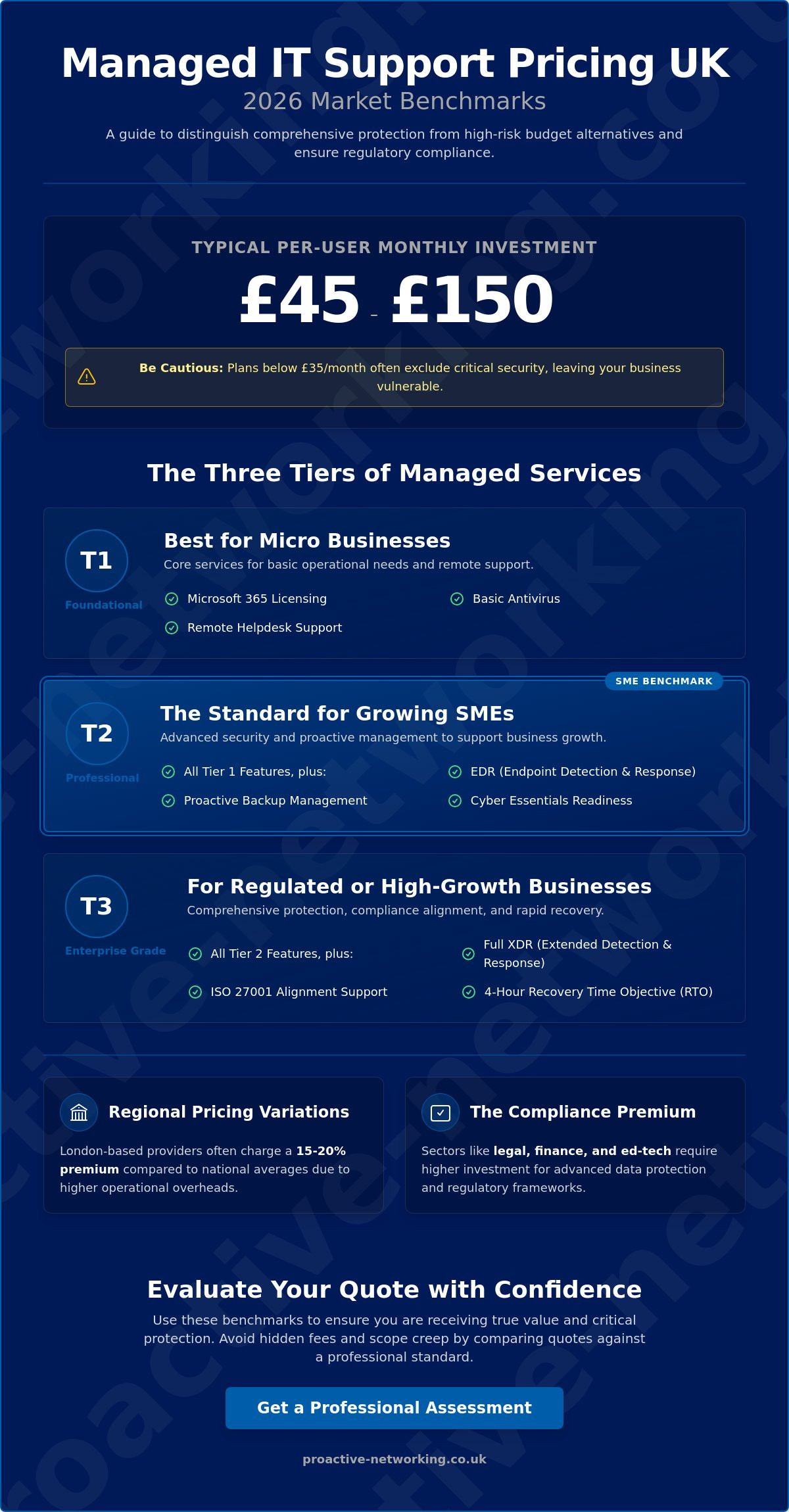
In 2026, the market for managed IT support pricing UK has stabilised into a clear range between £45 and £150 per user, per month. Whilst some providers offer entry level rates around £25 to £35, these often represent a significant risk. These budget tiers typically exclude critical security patches and proactive monitoring, leaving your infrastructure vulnerable to the very threats that modern IT is designed to prevent. A standard UK SME package now includes essential layers like email protection and local data backup as a baseline for operational safety.
For sectors with high regulatory burdens, such as legal, finance or education technology, fees naturally sit at the higher end of the spectrum. This premium is justified by the requirement for advanced compliance frameworks and more rigorous data protection standards. The evolution of UK cybersecurity legislation means that basic antivirus is no longer sufficient for businesses handling sensitive data. Investing in IT maintenance and support that includes sector specific compliance ensures your business remains protected against both digital threats and legal liabilities.
The Three Tiers of Managed Services
Understanding where your business sits within these tiers is essential for accurate budgeting:
Tier 1 (Foundational): Best suited for micro businesses, focusing on Microsoft 365 licensing, basic antivirus and remote helpdesk support.
Tier 2 (Professional): The benchmark for growing SMEs. It includes EDR (Endpoint Detection and Response), backup management and Cyber Essentials readiness.
Tier 3 (Enterprise Grade for SMEs): Offers comprehensive protection through full XDR, ISO 27001 alignment and a 4 hour Recovery Time Objective (RTO) for business continuity.
Regional Variations: London vs National Pricing
A London Weighting still exists, with capital based providers often charging a 15-20% premium due to higher operational overheads. However, the maturation of remote monitoring and management technology has allowed national providers to offer high tier standards at more competitive rates. This has levelled the playing field for many businesses. Those with heavy physical infrastructure or complex hardware requirements should still prioritise providers who can offer local on site support when remote resolution isn't possible. This ensures a steady leader is always available to handle physical technical challenges without delay.
The Security and Compliance Premium: What Are You Really Paying For?
Security has become the most significant variable in managed IT support pricing UK. In previous years, a provider might have simply installed a basic antivirus and called it a day. Today, the sophistication of threats requires a far more robust approach. When you see a price variance between two providers, it often reflects the depth of the protective layers they're deploying. A cheaper quote usually indicates a reactive stance, whilst a premium fee covers the active, 24/7 monitoring required to keep a modern business operational. This investment ensures that your infrastructure is not merely functional but resilient against evolving digital risks.
Many business owners ask why current quotes are higher than those they received three years ago. The answer lies in the cost of resilience. Attack Surface Reduction is no longer a luxury; it's a mandatory requirement for most UK cyber insurance policies. By hardening your systems and reducing potential entry points for attackers, a provider acts as a seasoned expert guarding your digital assets. The investment you make in high tier support is significantly lower than the potential £17.5 million fine or the total loss of operations following a ransomware event. This proactive involvement is what distinguishes a sophisticated partner from a simple service provider.
The Cost of Compliance: ISO 27001 and Cyber Essentials
Managing a compliance and security posture involves more than a one off certificate. When an MSP handles your ISO 27001 or GDPR roadmap, they're taking on a continuous management role. This differs from a simple compliance audit fee. Ongoing management ensures that your policies, user permissions and data handling remain compliant with the Data (Use and Access) Act 2025. For schools or legal firms, sector specific compliance adds another layer of complexity, requiring specialised knowledge that naturally carries a higher service cost to maintain the necessary high tier standards.
Advanced Threat Protection: EDR and XDR
Advanced security tools like Endpoint Detection and Response (EDR) and Extended Detection and Response (XDR) have replaced traditional anti malware. These systems don't just look for known viruses; they monitor for suspicious behaviour in real time. A premium contract often includes access to a 24/7 Security Operations Centre (SOC), where experts investigate alerts the moment they occur. XDR provides a holistic security layer that integrates email, sign in and endpoint protection into a single, unified defence strategy. This level of protection is now essential for any organisation handling sensitive client data or financial transactions, offering a sense of security and relief that basic tools cannot provide.
Evaluating Quotes: Avoiding Hidden Costs and "Scope Creep"
Comparing managed IT support pricing UK requires a discerning eye that looks beyond the initial per user headline. A common pitfall for SMEs is selecting a provider based on a low monthly fee, only to discover a labyrinth of out of scope charges later. To avoid this, you should demand a transparent breakdown of what is included in the core service. A professional proposal should act as a clear roadmap, establishing order and control over your technical environment from the outset. Use a checklist to verify if the quote includes 24/7 monitoring, patch management and essential security layers as standard.
One significant variable is the onboarding fee. This one off cost covers the initial audit, documentation and security hardening required to bring your systems up to a professional standard. Whilst some providers might waive this in exchange for a longer contract, others charge a substantial upfront sum. You should also scrutinise remote only contracts. These often appear cost effective until an engineer is required on site, at which point high hourly rates and travel expenses can quickly erode any perceived savings. A steady leader in the MSP space will typically include broadband and backup lines within your resilience budget to ensure total connectivity.
Project Work vs Ongoing Support
It's vital to distinguish between daily maintenance and major strategic changes. Activities such as company data mergers or separations are typically treated as project work rather than standard support. A proactive MSP will structure these fees clearly to avoid bill shock during periods of transition. Transparency also extends to Microsoft 365 licensing. You should confirm whether these are bundled into the per user fee or billed separately at cost, as this significantly impacts the true value of the contract. For businesses seeking a partner that prioritises long term stability, managed IT support should always provide a clear demarcation between support and project services.
The "Resilience" Variable: Backups and Continuity
There is a profound difference between a daily data backup and a comprehensive business continuity plan. Whilst a basic backup might satisfy some, a professional standard often requires a 4 hour recovery time objective to minimise operational impact. Additionally, managed domain hosting is frequently overlooked. A high tier provider will include the management of DMARC, SPF and DKIM security records as part of their standard protection. This ensures your email reputation is guarded against spoofing and phishing. Understanding these nuances is essential when comparing managed IT support pricing UK across different providers, as true unlimited support must encompass proactive maintenance, not just reactive fixes.
The Proactive Networking Approach: Premium Support for UK SMEs
Proactive Networking acts as a protective guardian for your business operations, standing as a steady leader in an often volatile technical landscape. With 25 years of experience, we have mastered the art of simplifying complex technical environments for our clients. We understand that in 2026, technology isn't just a tool; it's the foundation of your organisation's success. Our approach is built on the core principle of reassuring stability, providing a level of strategic foresight that only decades of high-tier expertise can deliver. We don't just manage your systems; we take proactive ownership of your technical resilience.
Our philosophy regarding managed IT support pricing UK is rooted in absolute transparency and order. We believe that professional partnerships thrive on trust, which is why we've eliminated the hidden extras and "out of scope" charges that plague the industry. Every contract we design focuses on comprehensive protection. We include ISO 27001 alignment and Cyber Essentials as standard pillars of our service, ensuring your business remains compliant with the Data (Use and Access) Act 2025. This commitment to high standards provides the security and relief you need to focus on your commercial growth.
Why Our Clients Choose Stability Over "Cheap" IT
Opting for the cheapest provider is often a false economy that leads to operational instability. Our clients value the peace of mind that comes from a 4-hour recovery objective and proactive EDR monitoring. We provide sophisticated solutions that go beyond basic helpdesk support, such as integrating Teams as a phone system and managing the intricacies of Microsoft 365 licensing. This expertise ensures your team stays connected and productive whilst maintaining the highest security posture. Our national coverage allows us to deliver a premium, personalised service standard to businesses across the UK, ensuring your infrastructure is always in expert hands.
Next Steps: Securing Your Business Future
Securing your business future begins with a strategic consultation rather than a simple price chat. We invite you to discuss your long-term technology roadmap with a seasoned consultant who understands your sector's specific challenges. Our on-boarding process is methodical and deliberate, designed to organise a seamless transition that establishes immediate control over your environment. We'll work with you to identify the exact level of support required to protect your operations and satisfy your compliance obligations. By choosing a partner with a 25-year heritage, you're investing in a relationship defined by longevity and quiet competence.
Protecting Your Operations with Strategic Clarity
Evaluating managed IT support pricing UK requires a shift in perspective from viewing technology as a basic utility to seeing it as a strategic investment in business continuity. We've established that 2026 market benchmarks reflect the essential costs of cyber-resilience and regulatory compliance. By prioritising transparency and understanding the total cost of ownership, you can avoid the financial pitfalls of hidden fees and scope creep that often accompany budget-tier contracts. A stable technical environment isn't built on reactive fixes; it's maintained through proactive guardianship and professional foresight.
Proactive Networking brings over 25 years of SME expertise to your organisation, acting as a dedicated partner for your digital landscape. As ISO 27001 and Cyber Essentials specialists, we include advanced EDR and XDR threat protection in our core service as standard. This ensures your infrastructure remains resilient against modern threats whilst simplifying the complexity of your operations. Our transparent approach provides the stability you need to grow with confidence.
Take the first step towards a secure technical future. Request a Transparent Managed IT Support Proposal and discover the relief of working with a partner that prioritises your success. Your business deserves the protection of a seasoned expert.
Frequently Asked Questions
What is the average cost of IT support for a small business in the UK?
Typical costs for a small business generally fall within the industry standard range of £50 to £150 per user, per month. This figure fluctuates based on the level of security and proactive monitoring your organisation requires. A foundational service might sit at the lower end of this scale, whilst enterprise-grade protection for highly regulated sectors like finance or legal will naturally reach the higher bracket.
Are Microsoft 365 licenses usually included in the per-user price?
Microsoft 365 licenses are generally billed as a separate line item rather than being bundled into the core support fee. This ensures total transparency, as licensing costs are set by Microsoft and can change based on the specific plan you choose. Whilst some providers offer bundled packages, it's vital to check if you're paying a premium for this convenience instead of paying for the licenses at cost.
Do managed IT support prices include on-site visits?
On-site visits are included in many comprehensive support contracts, though "remote-only" agreements are a common alternative. It's essential to verify if your contract covers physical call-outs or if these incur additional hourly rates and travel expenses. For hardware-heavy businesses, inclusive on-site support provides a predictable budget and ensures a steady leader is available to handle physical technical challenges that remote tools cannot resolve.
What are the typical one-off on-boarding fees for new IT support?
On-boarding fees are one-off charges that cover the initial audit, documentation of your infrastructure and the implementation of security standards. These fees vary between providers based on the complexity of your environment and the amount of remedial work required to bring your systems up to a professional standard. Some MSPs may waive this fee in exchange for a longer-term commitment, whilst others prioritise a thorough initial setup.
How much extra does it cost for 24/7 IT support in the UK?
24/7 support typically incurs a premium of 20% to 50% over standard business-hours pricing. This additional investment covers the cost of a Security Operations Centre (SOC) that monitors your environment around the clock to prevent breaches. For organisations handling sensitive data or operating across multiple time zones, this continuous protection is a necessary pillar of their risk management strategy and overall business continuity plan.
Is Cyber Essentials certification included in managed IT support packages?
Many professional packages include the technical management required for Cyber Essentials readiness, though the external audit and certification fees are often billed separately. A sophisticated partner will ensure your systems meet the necessary standards for compliance as part of your ongoing managed IT support pricing UK. This proactive approach simplifies the certification process and reinforces your overall security posture against common digital threats.
What happens to the price if my business grows or shrinks during the contract?
The per-user pricing model is designed to scale dynamically as your headcount changes. Most managed service providers adjust your monthly invoice based on the active number of users or mailboxes in your system at that time. This flexibility ensures you don't pay for unused capacity whilst allowing for seamless growth as you add new team members, providing a scalable framework that matches your commercial reality.
Why do some IT companies charge for an initial audit or site survey?
An initial audit or site survey is a professional requirement to identify potential vulnerabilities and infrastructure weaknesses before support begins. This deep dive allows a provider to understand your current technical landscape and provide an accurate, transparent quote without hidden surprises. It ensures that both parties have a clear understanding of the infrastructure's health and any necessary improvements required to establish long-term stability and security.


Comments