


Managed Cloud Services: A Strategic Guide to Transitioning Your SME in 2026
- Simon Raine
- Jun 3
- 12 min read
With over 50% of enterprise IT spending now dedicated to cloud based solutions, why do so many British SMEs still feel tethered to the mounting costs and physical vulnerabilities of on site servers? It's a valid concern. You likely recognise that maintaining legacy hardware is becoming an unsustainable financial burden, yet the anxiety surrounding data security during a migration or the intricacies of managed cloud services can feel overwhelming. We understand that you need more than just a technical shift; you require a sophisticated partner to act as a protective guardian for your digital assets.
This guide offers a strategic framework to master your transition, designed specifically to enhance security and operational efficiency for your business. You'll learn how to align with the 2026 regulatory environment, including the updated Cyber Essentials requirements and NIS Regulations, whilst achieving a seamless move to a modern IT infrastructure. We will walk through the essential steps to ensure your migration is stable, your monthly costs are predictable, and your compliance standards remain beyond reproach.
Key Takeaways
Understand the shift from reactive "break-fix" IT to a proactive model where managed cloud services act as a strategic framework for your business resilience.
Learn how to execute a thorough audit of your current hardware and software licences to distinguish between cloud-ready applications and legacy systems.
Master a phased migration strategy that prioritises a secure landing zone and pilot testing to protect your operational continuity throughout the transition.
Identify the essential multi-layered security protocols, such as EDR and XDR, required to reduce your attack surface and ensure regulatory compliance.
Discover how proactive monitoring and regular infrastructure reviews ensure your modern IT environment remains optimised as your SME scales.
Table of Contents
Understanding Managed Cloud Services for the Modern British SME
Evaluating Your Infrastructure: How to Prepare for Cloud Adoption
A Step-by-Step Guide to Transitioning Your Business to the Cloud
Securing Your Cloud Environment: Managing Risks and Compliance
Optimising Performance with a Proactive Managed Cloud Partner
Understanding Managed Cloud Services for the Modern British SME
For many British SMEs, the cloud has evolved from a simple storage utility into a foundational business strategy. Moving beyond the era of the dusty server room requires a shift in mindset. You aren't just buying space on someone else's computer; you're entering into a sophisticated model of managed services that ensures your operations remain resilient and agile. This transition marks the end of reactive IT, where you only speak to a technician when something breaks. Instead, managed cloud services provide a proactive environment where your systems are monitored and optimised before a failure can impact your bottom line.
By 2026, the demand for flexible working patterns has made this shift essential for recruitment and retention. British businesses now require secure, high performance access to data from any location. As a protective guardian for your company data, a managed service provider ensures that this accessibility doesn't come at the cost of security. They take on the burden of complex technical management, allowing you to focus on your core commercial objectives with total peace of mind.
The Core Components of a Managed Cloud Ecosystem
A modern cloud ecosystem is built on several pillars that work in harmony to support your growth. Infrastructure as a Service (IaaS) is the most significant shift, as it replaces the physical office server room with scalable, virtualised resources. This eliminates the cycle of expensive hardware refreshes every five years. Software as a Service (SaaS) integration, particularly through Microsoft 365, ensures your team remains productive with seamless access to essential tools. Proactive monitoring and managed backup protocols are woven into the fabric of the environment, providing a layer of business continuity that protects your data in any scenario.
Cost Efficiency vs Value: The SME Perspective
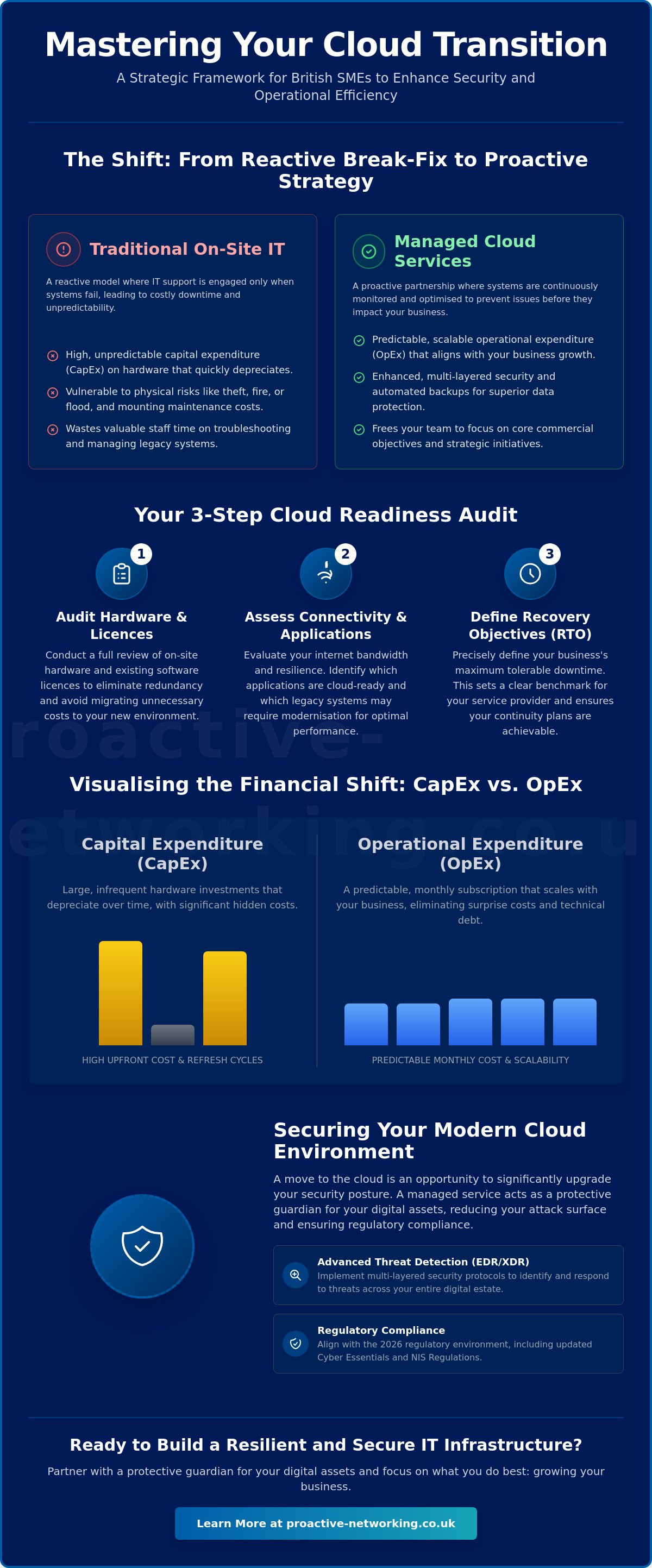
Traditional IT relies on capital expenditure (CapEx), requiring large, infrequent investments in hardware that begins to depreciate the moment it's installed. Transitioning to the cloud shifts this to a predictable operational expenditure (OpEx) model. This change removes the hidden costs of internal IT management, such as cooling, electricity and the significant time staff spend troubleshooting legacy systems. Managed cloud services are a strategic framework that reduces technical debt by replacing outdated, high maintenance systems with a modern, fully supported digital environment.
Evaluating Your Infrastructure: How to Prepare for Cloud Adoption
Before you commit to managed cloud services, you must undertake a rigorous assessment of your current technical estate. This isn't merely a box ticking exercise; it's about ensuring your foundation is stable enough to support a virtualised future. You should begin with a comprehensive audit of all on premises hardware and existing software licences. Many SMEs discover they are paying for redundant seats or maintaining servers that have long outlived their efficiency. Clear visibility of your assets prevents you from migrating unnecessary costs into your new environment.
Identifying which applications are cloud ready and which legacy systems require modernisation is a critical distinction. Some older software may not perform optimally in a cloud environment without significant reconfiguration. Alongside this software review, you must evaluate your physical connectivity. The cloud is only as reliable as your internet connection. Assessing your bandwidth requirements and investing in resilient backup lines ensures that your business remains operational even if your primary provider suffers an outage.
You must also define your Recovery Time Objectives (RTO) with precision. Knowing exactly how much downtime your business can tolerate allows you to build a migration plan that prioritises continuity. This strategic clarity prevents panic during the transition and sets a benchmark for your service provider. It ensures that your business continuity plans are realistic and achievable from day one.
Data Auditing and Cleanliness
A migration is the perfect opportunity to sanitise your data. Migrating years of digital clutter is inefficient and increases your storage costs. You should organise your company data to ensure only essential information moves to the new environment. If your business has recently experienced company data mergers or separations, this stage is vital for reconciling disparate filing systems. We also recommend a thorough review of your managed domain hosting. Ensuring your SPF, DKIM and DMARC protocols are correctly configured is a fundamental step in protecting your email reputation and preventing spoofing.
Setting Strategic Cloud Objectives
Successful cloud adoption is never just about the technology; it's about the business outcome. Your objectives should align with your plans for scalability and growth. For businesses in highly regulated fields like the legal or finance sectors, sector specific compliance consultancy is mandatory. You must ensure that your data handling remains within the boundaries of ISO 27001 and GDPR. Identifying internal cloud champions amongst your leadership team will also help bridge the gap between technical change and staff adoption, ensuring the transition is welcomed rather than resisted.
A Step-by-Step Guide to Transitioning Your Business to the Cloud
Transitioning to managed cloud services requires a methodical framework to ensure your operations remain stable and secure. This isn't a process that should be rushed. By following a four phase approach, we can mitigate risk and maintain the integrity of your data throughout the move. The first phase involves creating a secure landing zone. This is a pre configured environment where your security policies, such as email, user and sign in protection, are established before any data arrives. It ensures that your new digital home is locked down from the moment it's activated.
Once the foundation is set, we move to a pilot migration. This stage allows a small group of users to test application performance and user experience in a live environment. It's the best way to identify any latency issues or workflow bottlenecks before the full transition. Following a successful pilot, the full data migration begins. During this phase, we prioritise business continuity, ensuring that your team can continue to work whilst the heavy lifting happens in the background. This structured approach within the ecosystem of managed cloud services ensures that your business doesn't just move to the cloud but thrives within it. The final phase is post migration optimisation. Here, we refine your settings and provide staff training to ensure everyone is comfortable with their new cloud workflows.
Ensuring Minimal Disruption During Migration
We understand that downtime is not an option for a growing SME. To maintain productivity, we schedule significant data transfers outside of peak business hours, often during evenings or weekends. Proactive monitoring plays a vital role here, as it allows us to identify and resolve potential bottlenecks before they impact your staff. When the go live moment arrives, providing immediate technical support is essential. Having experts on hand to answer questions and resolve minor setup issues ensures that your team feels supported and confident from day one.
Microsoft 365 and Teams Integration
A central part of many cloud transitions involves Microsoft 365 licensing. We help you audit your current seats to ensure you're only paying for the tools your team actually uses. Many businesses also find great value in using Microsoft Teams as a phone system. By integrating your telecommunications into your cloud environment, you create a unified communication hub that works anywhere. Transitioning to a unified, cloud based communication centre ensures that clients receive consistent, professional responses regardless of where your team is located.
Securing Your Cloud Environment: Managing Risks and Compliance
Many organisations mistake the cloud for a simple destination, but for the modern SME, it must be treated as a security-first operating model. In 2026, the regulatory environment for managed cloud services has become significantly more stringent. With medium and large MSPs now falling under the scope of the Network and Information Systems (NIS) Regulations 2018, the responsibility for implementing robust security measures is no longer optional. This shift requires a move away from perimeter-based security toward a multi-layered approach that protects data regardless of where it resides.
Implementing Endpoint Detection and Response (EDR) and Extended Detection and Response (XDR) is the cornerstone of this protective strategy. These tools provide visibility across your entire digital estate, allowing for the rapid identification and neutralisation of threats. By focusing on attack surface reduction, you can eliminate unnecessary entry points that cyber criminals often exploit. This proactive stance ensures that your business doesn't just react to breaches but actively prevents them from occurring in the first place. For those seeking to fortify their digital perimeter, our team provides comprehensive cyber security solutions tailored to these modern threats.
Compliance is the second pillar of a secure cloud environment. Your provider must adhere to recognised standards such as ISO 27001 and the latest Cyber Essentials requirements. The April 2026 update to the Cyber Essentials scheme introduced stricter mandates, including compulsory multi-factor authentication (MFA) for all cloud services. Maintaining GDPR compliance also remains a priority, requiring encrypted cloud storage and strict data residency controls to ensure your information stays within the appropriate legal jurisdictions. This level of oversight is particularly critical for firms in the legal and finance sectors, where data integrity is a regulatory necessity.
Advanced Threat Protection in the Cloud
Deploying anti-phishing and anti-malware tools that are specifically engineered for cloud email environments is essential. These systems use machine learning to identify sophisticated social engineering attempts that traditional filters might miss. Managed sign-in protection and MFA act as your final line of defence, ensuring that compromised credentials don't lead to a full system breach. Proactive networking monitoring further enhances this by detecting subtle anomalies in traffic patterns, allowing for intervention before a minor issue escalates into a significant incident.
Regulatory Adherence and Auditing
Preparing for a GDPR audit is a far simpler task when your cloud data flows are clearly documented and access controls are strictly enforced. Managed cloud services simplify the Cyber Essentials accreditation process by providing the necessary evidence of technical compliance. For legal, finance and education firms, sector-specific compliance consultancy ensures that your cloud environment meets the unique demands of your industry regulators. This structured approach to auditing provides the transparency required to satisfy both clients and governing bodies whilst maintaining the highest standards of data protection.
Optimising Performance with a Proactive Managed Cloud Partner
Transitioning to the cloud is a significant milestone, but the real value of managed cloud services is realised through ongoing optimisation. A static environment quickly becomes inefficient as your business evolves. By partnering with a proactive expert, you ensure your infrastructure doesn't just exist but actively supports your growth. Proactive monitoring and rapid response technical support are essential safeguards that maintain your operational momentum. Regular infrastructure reviews allow us to identify when your environment needs to scale, ensuring you never pay for resources you don't use whilst always having the power you need.
Choosing a local UK partner offers a distinct advantage over global giants. Whilst massive vendors provide scale, they often lack the nuanced understanding of the British market and the specific challenges faced by local SMEs. A dedicated partner acts as a protective guardian, offering expert consultancy that prioritises your business resilience and disaster recovery. This personalised approach ensures that your technical strategy is always aligned with your commercial reality. We remain unfazed by technical challenges, projecting an image of quiet competence that allows you to focus on your core objectives.
Continuous Improvement and Scalability
Efficiency in the cloud is an iterative process. We regularly review your usage patterns to identify cost saving opportunities, ensuring your investment remains lean and effective. As your needs change, we help you implement new features that drive productivity. For example, integrating Microsoft Teams as a primary phone system can unify your communications and improve the client experience. These incremental improvements, supported by a long term professional relationship, ensure your IT estate remains a competitive asset rather than a legacy burden. Global providers often ignore these communication nuances, but we recognise they are vital for professional standards.
The Proactive Networking Advantage
Our 25 years of experience provides the stability and foresight required to secure your transition to managed IT support for small business UK. We don't view cloud migration as a standalone event. Instead, we integrate multi layered cyber security for smes into every project we undertake. This comprehensive approach ensures that your data remains protected whilst your team enjoys the flexibility of a modern workspace. If you're ready to move beyond the limitations of on site hardware, contact us to discuss your bespoke cloud roadmap and secure the future of your business.
Future-Proofing Your Business Infrastructure
The transition to a modern IT environment is a defining moment for any British SME. It's a move that replaces the limitations of physical hardware with a scalable, resilient framework. By prioritising a structured migration and multi layered security, you ensure your operations remain both agile and compliant with the latest 2026 standards. Adopting managed cloud services isn't just about storage; it's about building a foundation that supports your long term growth whilst protecting your most valuable digital assets.
Proactive Networking Ltd brings over 25 years of SME IT expertise to your project. As an ISO 27001 and Cyber Essentials certified partner, we specialise in the complex compliance requirements of the legal and financial sectors. We act as your protective guardian, simplifying the technical landscape so you can focus on your commercial success. Our team remains a steady leader in an ever changing field, ensuring your transition is seamless and your systems are dependable.
Secure your business future with a bespoke managed cloud strategy from Proactive Networking Ltd. We look forward to helping you achieve a more efficient and secure digital future.
Frequently Asked Questions
What are the main benefits of managed cloud services for small businesses?
The primary benefits include enhanced cyber security, seamless scalability, and the shift to a predictable operational expenditure model. By utilising managed cloud services, your business gains access to enterprise level infrastructure that would be prohibitively expensive to maintain on site. This allows your team to work securely from any location whilst we act as the protective guardian of your digital operations.
How much do managed cloud services typically cost for a UK SME?
The cost of transitioning to the cloud depends entirely on the complexity of your current infrastructure, the number of users, and your specific security requirements. Every business has unique needs, which is why we provide bespoke roadmaps rather than generic estimates. This ensures that your investment aligns with your commercial objectives and that you only pay for the licences and support your business actually requires.
Is my data more secure in the cloud than on an office server?
Cloud environments are typically more secure than physical office servers because they benefit from continuous monitoring and multi layered security protocols. Your data is stored in high tier data centres with physical protections that most SMEs cannot replicate. When combined with EDR and XDR solutions, these environments offer a level of resilience that significantly reduces your vulnerability to modern cyber threats.
How long does it take to migrate a business to the cloud?
A typical migration can take anywhere from a few weeks to several months, depending on the volume of data and the complexity of your legacy applications. We follow a methodical four phase approach to ensure minimal disruption. This starts with a secure landing zone and moves through a pilot phase before the final data transfer, ensuring every step is validated before we proceed.
Can I use Microsoft Teams as my primary phone system with managed cloud?
You can absolutely use Microsoft Teams as your primary phone system through a unified communication setup. This integration allows your staff to make and receive external calls directly through the Teams interface on any device. It's a sophisticated way to consolidate your telecommunications into your cloud environment, ensuring your team remains reachable whether they are in the office or working remotely.
What is the difference between managed cloud and traditional IT support?
Traditional IT support often operates on a reactive break-fix basis, whereas managed cloud services focus on proactive management and strategic foresight. Instead of simply resolving issues after they occur, we monitor your infrastructure to prevent downtime before it happens. This model provides a comprehensive partnership where we manage the entire technical landscape to ensure it scales with your business.
How does managed cloud help with ISO 27001 or GDPR compliance?
Managed cloud environments simplify compliance by providing built in encryption, data residency controls, and detailed audit trails. These features are essential for meeting the strict requirements of ISO 27001 and GDPR. For firms in the legal and finance sectors, this ensures that sensitive client information is handled according to industry specific regulations, with all security measures documented for future audits.
What happens if our internet connection goes down whilst using cloud services?
If your primary internet connection fails, your cloud services remain active and accessible via mobile data or alternative networks. To prevent such disruptions, we recommend implementing resilient broadband and backup lines. This ensures that your office remains connected to your cloud environment even if your main provider suffers an outage, maintaining your business continuity without compromise.


Comments