


DKIM Security for Business Email: The Professional Guide to Email Authentication
- Simon Raine
- Jun 1
- 12 min read
With AI phishing attacks surging by over 1,200 per cent, your professional correspondence is under constant threat from sophisticated impersonators. Simply hitting send is no longer enough. You need a definitive way to prove your identity to every receiving server. Implementing robust dkim security for business email has shifted from a technical recommendation to a mandatory requirement for maintaining deliverability and trust.
We understand the frustration of seeing critical emails flagged as spam or the anxiety that comes with the rising tide of business email compromise. You've likely found the technical jargon of DNS settings more confusing than helpful, yet the stability of your brand depends on getting these configurations right. This guide will demystify DKIM, explaining how it acts as a digital seal of authenticity that protects your reputation whilst ensuring your emails reach their intended destination.
You'll learn how this authentication method fits into a comprehensive security strategy to keep your operations secure and your communications reliable. We'll move from the broad importance of identity verification to the specific steps required to fortify your domain against modern threats.
Key Takeaways
Understand how DKIM acts as a digital seal to verify the integrity of your messages and protect your professional reputation.
Learn the simplified mechanics of the cryptographic handshake and why it is the gold standard for verifying sender identity.
Discover how dkim security for business email integrates with SPF and DMARC to build a comprehensive defence against phishing and spoofing.
Improve your sender reputation with major providers to ensure your critical communications reach the inbox rather than the junk folder.
Recognise the importance of professional management to avoid technical DNS errors that can disrupt your business email flow.
Table of Contents
Understanding DKIM: The Digital Signature Protecting Your Business Reputation
Trust is the foundation of every commercial relationship, yet standard email remains fundamentally insecure. When you send an email without authentication, it's akin to sending a postcard through the mail; anyone who handles it can read or alter the contents. DomainKeys Identified Mail (DKIM) was developed to solve this vulnerability by providing a cryptographic method to validate a domain name identity. It acts as a digital seal of authenticity that ensures the message you sent is exactly what the recipient receives.
As of early 2026, major providers like Google, Yahoo, and Microsoft have moved beyond recommending these protocols to strictly mandating them. For any organisation sending bulk communications, failing to implement robust dkim security for business email now results in immediate rejection or a direct path to the junk folder. This shift reflects a broader industry commitment to zero trust authentication, where every interaction must be verified before it's permitted into a user's inbox.
Why Business Email Needs a Seal of Authenticity
The rise of business email compromise (BEC) has created a significant threat to UK SMEs, particularly those within the legal and finance sectors where sensitive documents are frequently exchanged. Spoofing allows criminals to impersonate senior leadership, often leading to the unauthorised redirection of funds or the theft of intellectual property. In 2023 alone, BEC scams resulted in $2.9 billion in global losses, a figure that continues to climb as attackers use AI to craft more convincing deceptions.
By using DKIM, you're applying a digital wax seal to your correspondence. If a malicious actor attempts to intercept and modify an invoice or a contract whilst it's in transit, the cryptographic hash will no longer match. The receiving server identifies this discrepancy and flags the message as untrustworthy. This protection is vital for maintaining the integrity of your professional reputation and ensuring that your clients feel secure when interacting with your brand.
The Core Components of a DKIM Record
Implementing dkim security for business email involves a sophisticated two part process that happens behind the scenes. First, your outgoing mail server applies a unique digital signature to the header of every email sent. This signature is generated using a private key that only your organisation possesses, ensuring that the mark of authenticity cannot be forged by outsiders.
The second component is the public key, which is stored within your domain's DNS records. When an email arrives, the recipient's server retrieves this public key to perform a verification check. If the signature is valid, it proves two critical facts: the email truly originated from your domain and the content hasn't been tampered with since it was signed. This seamless handshake provides the stability and security required for modern corporate communications without adding friction to the user experience.
How DomainKeys Identified Mail Works: The Cryptographic Handshake
The technical elegance of DKIM lies in its use of asymmetric encryption. This method involves a pair of keys: one private and one public. Your outgoing mail server holds the private key securely, using it to generate a unique digital signature for every message. This signature is then embedded into the email header, acting as a verifiable proof of origin. Because the public key is hosted openly in your DNS records, any receiving server can verify the signature without needing access to your private infrastructure. It's a sophisticated email authentication protocol that establishes trust without compromising your internal security.
The Signing Process at the Outgoing Server
When you click send, your mail server performs a series of calculations before the message ever leaves your network. It takes specific parts of the email, such as the "From" address, the "Subject" line, and the entire body content, to create a unique cryptographic hash. This hash is then encrypted with your private key to form the DKIM signature. By including the body of the email in this process, dkim security for business email ensures that even a single character change by an interceptor will invalidate the signature. This level of precision is what makes the protocol so effective at preventing unauthorised alterations.
Verification at the Recipient Side
On the receiving end, the process is entirely automated and invisible to the user. The recipient's server identifies the DKIM signature in the header and looks up the corresponding public key in your DNS. It then decrypts the signature and recalculates the hash of the received message. If the two values match perfectly, the server knows the email is authentic. If they don't match, the message is treated with suspicion. This silent handshake happens in milliseconds, providing a seamless layer of protection for every interaction. For organisations looking to bolster their defences, managed domain hosting ensures these complex DNS configurations remain accurate and secure.
One of the primary advantages of this system is its resilience during email forwarding. Unlike other authentication methods that rely on the IP address of the sender, dkim security for business email is tied directly to the message content. When an email is forwarded through an intermediary server, the signature remains intact. This ensures that your professional communications retain their verified status even as they move through complex routing paths. If a check fails, the receiving server follows your predefined DMARC policy, which might involve placing the email in a quarantine folder or rejecting it entirely to protect the recipient from potential fraud.
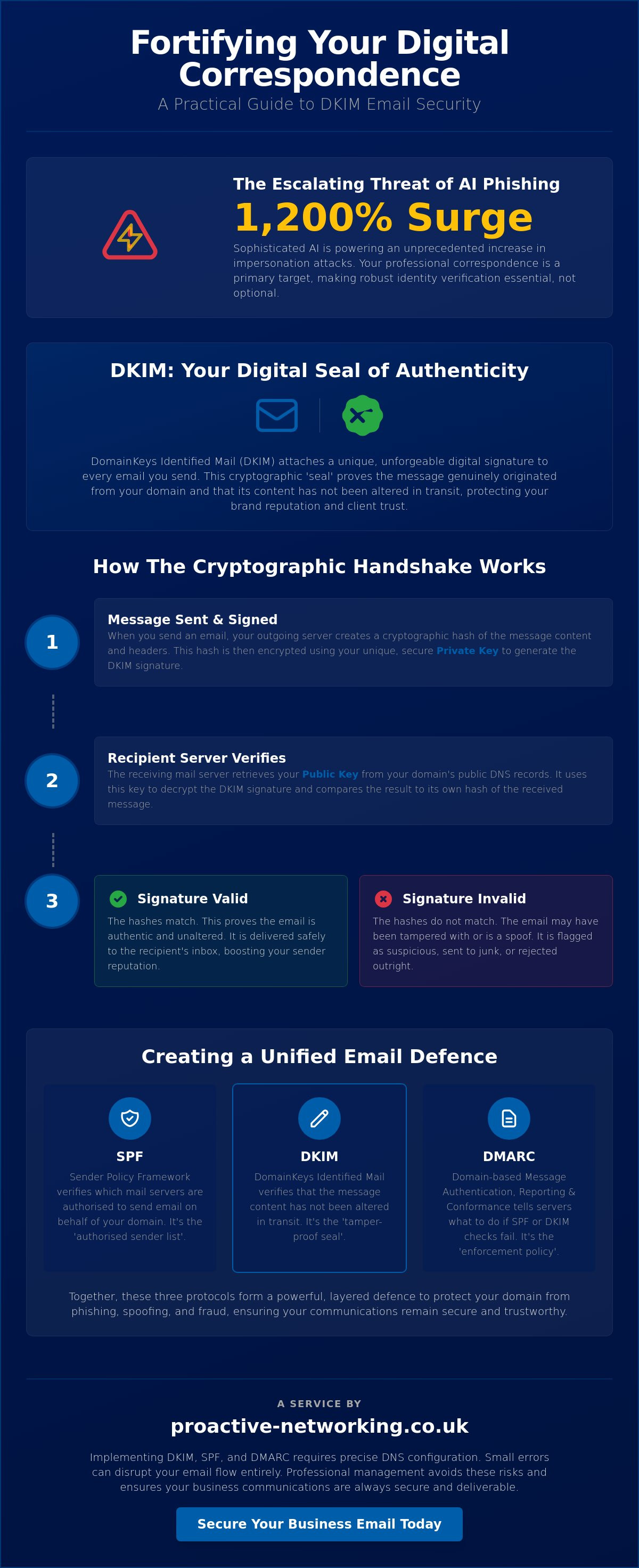
DKIM vs SPF vs DMARC: Creating a Unified Email Defence
To achieve true resilience, your organisation must move beyond isolated settings and adopt a cohesive strategy. Whilst the cryptographic handshake provides integrity, it works best alongside its counterparts: SPF and DMARC. Think of SPF as the guest list at a secure facility; it defines which IP addresses are authorised to enter. DKIM, however, is the individual ID badge that verifies the person's identity regardless of how they arrived. Finally, DMARC acts as the security manual, providing clear instructions on what to do if someone isn't on the list or lacks a valid badge.
The Limitations of SPF without DKIM
SPF has a significant weakness: it frequently breaks when emails are forwarded or sent through mailing lists. This is because the IP address of the forwarding server won't be on your original guest list. This is where dkim security for business email becomes indispensable. Because the signature is attached to the email content itself, it survives these transitions. By combining the identity checks of SPF with the integrity verification of DKIM, you create a robust defence that remains effective even as messages move through complex relays. For those seeking a deeper technical dive, Microsoft's technical guide on DKIM offers an excellent resource for configuration within a corporate environment.
The Strategic Importance of DMARC
DMARC is the strategic layer that brings these protocols together. It uses the results from both SPF and DKIM to determine whether an email is legitimate. Without DMARC, a receiving server might see a failed check but not know how to react, often defaulting to a cautious but inconsistent approach. By implementing a DMARC policy, you take control of your domain's reputation. We recommend a phased approach, starting with a monitoring policy before moving to quarantine or reject as your authentication matures. This level of oversight is a cornerstone of our multi layered cyber security guide, which details how email authentication fits into a broader protective framework for UK businesses.
Relying on a single protocol is no longer sufficient. If you only use SPF, your forwarded mail will fail. If you only use DKIM, you lack the IP based validation that many filters still prioritise. A unified approach ensures that your brand remains protected from spoofing whilst maintaining the highest possible deliverability rates. This structured coordination reflects a mature approach to IT maintenance and monitoring, ensuring that your communication channels remain both open and secure.
Why DKIM is Essential for Modern Business Deliverability and Compliance
Whilst earlier sections explored the mechanics of authentication, the commercial impact of dkim security for business email is most visible in your deliverability rates. Your sender reputation is a dynamic score maintained by providers like Gmail, Outlook, and Yahoo. When you consistently send authenticated mail, these providers view your domain as a low risk entity. This trust is the primary factor that determines whether your correspondence lands in the primary inbox or is relegated to the junk folder, where it's likely to be ignored by your clients.
As of 2026, the landscape has shifted from best practice to a rigid requirement. Major mailbox providers now mandate that bulk senders, defined as those sending over 5,000 emails per day, must have SPF, DKIM, and DMARC implemented. Failing to meet these standards doesn't just risk a minor delay; it often results in the immediate rejection of your messages. For a professional organisation, the cost of missed communications, such as unread invoices or lost contracts, far outweighs the effort required to secure your domain infrastructure.
Boosting Email Deliverability and Inbox Placement
Unauthenticated email is increasingly blocked by default to protect users from the 1,200 per cent increase in AI driven phishing attacks recorded in recent years. When your server signs a message, it provides a signal of quality that filters prioritise. This is particularly critical for long term marketing success and client retention. If your domain builds a history of failed or missing signatures, providers will eventually throttle your traffic, making it nearly impossible to reach your audience. Maintaining a clean reputation ensures that your legitimate business growth isn't hampered by technical oversights.
Meeting Regulatory and Industry Standards
For UK businesses, dkim security for business email is a vital component of regulatory compliance. Under GDPR, organisations are required to implement appropriate technical measures to ensure the integrity and confidentiality of personal data. Since email is the primary medium for exchanging such data, using cryptographic signatures is a logical step in demonstrating your commitment to these principles. Authentication is also a key requirement for achieving the UK Cyber Essentials certification, which many government and local authority contracts now mandate as a prerequisite for bidding.
In sectors such as law and finance, where we specialise in providing managed IT support for small business, the expectations for secure communication are even higher. Clients in these industries expect a premium standard of protection that guards against impersonation and fraud. Implementing DKIM isn't just about ticking a box; it's about projecting an image of stability and strategic foresight. To ensure your domain is fully protected against modern threats, consider our professional Managed Domain Hosting services to oversee your authentication protocols.
Implementing DKIM Security: Why Professional Management Matters
Whilst understanding the cryptographic handshake is essential, the actual implementation of dkim security for business email presents a significant technical challenge for many organisations. Attempting a "do it yourself" approach often leads to unintended consequences, such as broken email flows or persistent DNS errors that can take days to resolve. For businesses in the legal and finance sectors, where communication uptime is non negotiable, these risks represent a credible threat to operational stability.
The Complexity of DNS Management
Your DNS records are the backbone of your online identity, yet they're incredibly sensitive to syntax errors. Configuring CNAME and TXT records for DKIM requires precision; a single misplaced semicolon or an incorrect selector name will cause verification to fail immediately. The situation becomes even more complex when you use multiple email services. For example, your primary Microsoft 365 environment, your Xero accounting software, and your Mailchimp marketing platform each require their own unique selectors and keys. Managing these whilst ensuring they don't conflict with one another demands a high level of technical expertise and rigorous testing before any changes go live.
Beyond the initial setup, maintaining dkim security for business email involves ongoing vigilance. Security best practices dictate that cryptographic keys should be rotated regularly to minimise the impact of a potential compromise. If you use the same key for years, you're providing attackers with a much larger window of opportunity. Professional management ensures that these rotations happen seamlessly, without disrupting your daily operations or triggering false positives in recipient spam filters.
Our Proactive Approach to Domain Hosting
At Proactive Networking Ltd, we act as a protective guardian for your digital infrastructure. Our Managed Domain Hosting including DMARC, SPF and DKIM security takes the complexity out of your hands, allowing you to focus on your core business activities. We don't just perform a one time configuration. We provide continuous monitoring to ensure your authentication remains valid and effective against evolving threats. This proactive involvement is a critical part of a wider business continuity plan, ensuring that your communication channels remain resilient and your professional reputation stays untarnished.
We integrate email protection into a broader security strategy that includes IT maintenance, support, and monitoring. By centralising the management of your authentication protocols, we reduce your attack surface and ensure that every message sent from your domain carries the weight of verified authority. This structured approach provides the composed and dependable security your clients expect from a premium service provider.
Securing Your Professional Correspondence for the Future
The transition from an optional best practice to a mandatory requirement for email deliverability is now complete. By establishing a robust cryptographic identity, you ensure that your domain remains trusted by major providers and protected from the rising tide of impersonation. Implementing dkim security for business email is no longer just a technical checkbox; it's a fundamental commitment to the integrity of your brand and the security of your clients. This proactive approach safeguards your reputation whilst ensuring that every critical message reaches its intended destination without interference.
Managing these complex DNS configurations requires a partner with the strategic foresight to navigate evolving standards. With over 25 years of IT support experience, Proactive Networking Ltd specialises in the high level compliance needs of the legal and financial sectors. As Cyber Essentials and ISO 27001 specialists, we provide the stability and expertise required to maintain your domain's reputation. We act as a protective guardian for your infrastructure, ensuring your authentication protocols remain valid and effective.
Secure your business domain with expert DKIM management and take the definitive step towards a more resilient digital future. Your communications deserve the protection of a seasoned expert who understands the complexities of modern email security.
Frequently Asked Questions
Is DKIM enough to stop all phishing attacks against my business?
No, DKIM is not a complete solution on its own. It verifies that a message hasn't been tampered with, but it doesn't prevent attackers from using visually similar domains or compromised accounts. To be truly effective, dkim security for business email must be integrated with SPF and DMARC to create a comprehensive barrier against impersonation and spoofing.
What is the difference between a DKIM selector and a DKIM record?
A DKIM record is the actual entry in your DNS that holds your public key, whilst a selector is a unique string that points to that specific record. Think of the record as the lock and the selector as the label telling the recipient's server which key to use. This allows you to use different keys for various services like Microsoft 365.
Will setting up DKIM slow down my email delivery speeds?
No, implementing DKIM won't have a noticeable impact on your email delivery speeds. The cryptographic signing and verification processes happen in fractions of a second. Any minor processing time is far outweighed by the deliverability benefits, as unauthenticated emails face much longer delays or total rejection by modern filters that prioritise verified senders.
Do I need a different DKIM record for every person in my company?
No, you don't need individual records for each employee. DKIM applies to the domain as a whole. Every person sending from your corporate mail server uses the same signature. You only need additional records if you use external platforms, such as Xero or Mailchimp, to send mail on your domain's behalf. Each service requires its own unique selector.
What happens if my DKIM signature does not match the public key?
If the signature doesn't match the public key, the receiving server will fail the authentication check. The outcome depends on your DMARC policy. The email might be delivered with a warning, moved to the junk folder, or rejected entirely. This mismatch usually suggests that either the email was modified in transit or the DNS records are incorrectly configured.
Can I use DKIM if I use a third party service like Mailchimp to send newsletters?
Yes, you can and should use DKIM with third party services. Most reputable providers will ask you to add a specific record to your DNS settings. This allows them to sign your newsletters with your domain's authority, which is essential for maintaining your sender reputation and ensuring high engagement rates. It's a standard requirement for professional bulk sending.
How often should my business rotate its DKIM keys for security?
We recommend rotating your keys every six to twelve months as part of a robust security posture. Regular rotation is a standard best practice that limits the damage if a private key is ever compromised. Managing this cycle is a key part of maintaining dkim security for business email without causing interruptions to your communication flow or deliverability.
Does DKIM encrypt the actual content of my email for privacy?
No, DKIM doesn't provide encryption for privacy. Its purpose is to ensure integrity and authenticity, proving the email hasn't been altered and truly came from your domain. If you need to keep the actual content of your messages private from prying eyes, you'll need to implement separate end to end encryption or secure file sharing solutions.


Comments