


Sector Specific Compliance Consultancy: A Professional Guide for UK SMEs
- Simon Raine
- 1 day ago
- 12 min read
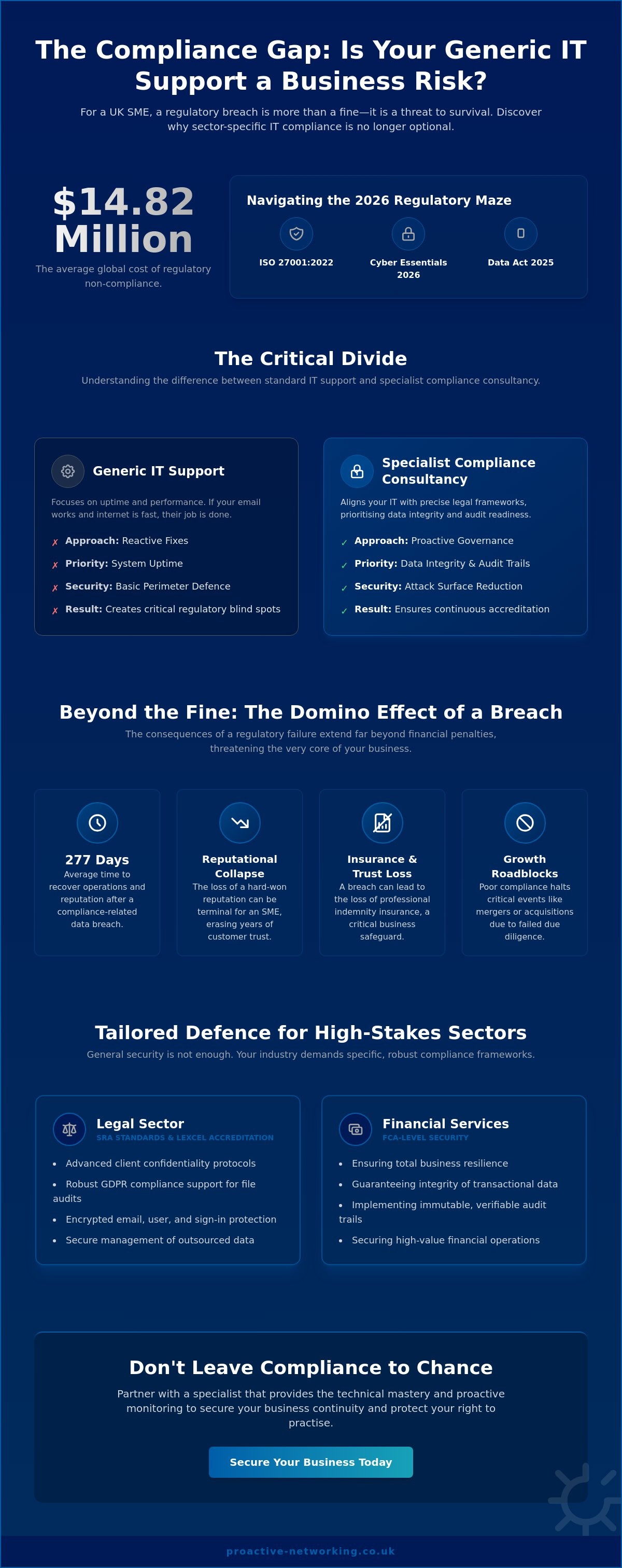
Did you know that the average cost of regulatory non compliance has now risen to $14.82 million globally? For a UK SME, even a small fraction of that penalty could be catastrophic, which is why many leaders now turn to sector specific compliance consultancy to protect their operations. It's understandable if you feel a sense of dread when faced with the overlapping demands of ISO 27001:2022, the 2026 Cyber Essentials Danzell update and the Data (Use and Access) Act 2025. Managing these whilst maintaining daily operations is a significant burden, especially when legacy IT systems fail to support modern auditing requirements.
We promise to show you how a specialist partner aligns your IT infrastructure with these complex regulations to ensure total business resilience. In this guide, we'll explore the path to creating a secure, audit ready environment that eliminates regulatory blind spots. You'll discover how to shift the technical burden of compliance away from your internal teams, allowing you to organise your resources around core objectives with complete peace of mind and the confidence of a seasoned expert at your side.
Key Takeaways
Understand why generic IT support often leaves critical regulatory blind spots and why a tailored approach is essential for high stakes sectors.
Learn how to align your infrastructure with exacting standards such as SRA requirements for solicitors and FCA level security for financial firms.
Discover how foundational frameworks like ISO 27001 and Cyber Essentials integrate with proactive measures like Attack Surface Reduction to ensure audit readiness.
Identify the critical criteria for selecting a sector specific compliance consultancy that understands both the legal landscape and your underlying IT infrastructure.
Explore how a dedicated partner acts as a protective guardian by providing technical mastery and proactive monitoring to secure your business continuity.
Table of Contents
Navigating the Regulatory Landscape: Why Generic Compliance Fails the Modern SME
Specialist Frameworks for High-Stakes Industries: Legal, Finance and Education
Aligning Cyber Security with Regulatory Standards: ISO 27001 and Cyber Essentials
Evaluating a Compliance Partner: A Framework for Strategic Selection
Proactive Networking: Your Protective Guardian in a Regulated World
Navigating the Regulatory Landscape: Why Generic Compliance Fails the Modern SME
A sector specific compliance consultancy is far more than a technical helpdesk; it's a strategic service that aligns your entire IT architecture with the precise legal frameworks governing your industry. Whilst many IT providers offer general security, they often lack the granular knowledge required to meet the stringent demands of the legal, financial, or education sectors. True Regulatory compliance requires a deep understanding of how data flows through your specific business processes, ensuring that every digital touchpoint meets the expectations of bodies like the SRA or the FCA.
In 2026, the UK's regulatory environment has reached a new level of complexity. With the Data (Use and Access) Act 2025 now in full effect and updated AML supervision protocols, the burden of proof has shifted onto SMEs. It's no longer enough to claim your systems are secure; you must prove it through continuous, verifiable audit trails. This is why a generic "one size fits all" approach creates dangerous blind spots. A standard IT provider might secure your perimeter, but they may fail to implement the specific data retention policies or encryption standards required for solicitors handling sensitive litigation files. A specialist consultant acts as a strategic guardian, ensuring your technology doesn't just work, but actually protects your right to practice.
The Distinction Between General IT and Compliance-Led Support
Generic IT support focuses almost entirely on uptime and performance. If your email is working and your internet is fast, they consider their job done. In contrast, compliance led support prioritises data integrity and the creation of immutable audit trails. Whilst a standard firewall is a useful first step, it's no longer sufficient for firms handling high value financial transactions or confidential legal documents. We implement proactive monitoring and Attack Surface Reduction to ensure your systems remain in a state of continuous accreditation. This shift from reactive fixes to proactive governance is what separates a stable business from one that's perpetually at risk of an audit failure.
The Cost of Non-Compliance in 2026
The consequences of a regulatory breach extend far beyond the immediate financial penalties. For many UK SMEs, the loss of professional indemnity insurance or the tarnishing of a hard won reputation can be terminal. We've seen how regulatory failures can abruptly halt critical business events, such as company data mergers or separations, because the underlying infrastructure couldn't meet the necessary due diligence standards. Security is now a prerequisite for growth. Industry reports indicate that the average time for a business to fully recover its operations and reputation following a compliance related data breach is now approximately 277 days.
Specialist Frameworks for High-Stakes Industries: Legal, Finance and Education
High stakes sectors require more than a general security posture. They demand a sector specific compliance consultancy that understands the granular requirements of regulatory bodies. For Barristers and Solicitors, this means aligning IT systems with SRA standards and Lexcel accreditation. These frameworks aren't just suggestions; they are the bedrock of professional practice. We ensure client confidentiality through advanced email, user, and sign in protection, whilst providing the necessary GDPR compliance support to manage complex file audits and outsourced data securely.
Legal Sector Compliance: Lexcel and SRA Standards
Maintaining the integrity of legal data requires a multi layered approach. Standard security often falls short when managing the high volume of sensitive documentation inherent in legal practice. We focus on securing the entire digital lifecycle, from encrypted communication to robust access controls. By implementing these specific measures, firms can meet their ethical obligations whilst protecting their reputation against increasingly sophisticated social engineering attacks.
Financial Services: Resilience and Data Integrity
In the financial sector, business continuity isn't just a best practice; it's a regulatory mandate. Firms must demonstrate that they can maintain operations and protect data integrity even during significant disruptions. This is particularly critical during company data mergers and separations, where FCA level security must be maintained across disparate systems. We deploy EDR and XDR solutions to provide the high level threat detection that modern auditors expect. Transitioning to the cloud also requires precision, utilising Microsoft 365 licensing specifically configured to meet financial governance standards.
Education Technology: Meeting DfE Requirements
UK schools face unique challenges as Education Technology becomes central to the curriculum. The Department for Education (DfE) has established rigorous cyber security standards for 2026 that schools must meet to protect student data and maintain operational stability. Our expertise in cyber security for schools UK ensures that educational institutions can navigate these requirements with confidence. A fundamental starting point for any institution is the Cyber Essentials scheme, which provides the baseline controls necessary to block approximately 80% of common cyber attacks.
Across all these sectors, managed domain hosting with DMARC, SPF, and DKIM security is a non negotiable requirement. These protocols prevent email spoofing and ensure that your communications remain trusted by both clients and regulators. If you're concerned about your current level of protection, exploring sector specific IT support can provide the clarity needed to close your compliance gaps.
Aligning Cyber Security with Regulatory Standards: ISO 27001 and Cyber Essentials
Compliance is often viewed as a paperwork exercise, but true resilience stems from technical alignment. Engaging a sector specific compliance consultancy allows you to bridge the gap between abstract legal requirements and tangible IT controls. By focusing on established frameworks, businesses can move beyond basic security and build a robust foundation that satisfies even the most rigorous external audits. This approach ensures that your technology doesn't just support your business; it actively defends it.
ISO 27001: The Gold Standard for Information Security
ISO 27001 represents the pinnacle of information security management. Rather than just checking boxes, it requires the establishment of a formal Information Security Management System (ISMS). This system ensures that your people, processes, and technology all work in harmony to protect sensitive data. Since the transition period for the 2022 update ended in October 2025, all UK organisations must now adhere to the revised set of 93 controls. Our iso 27001 implementation support simplifies this complex accreditation process, turning a daunting technical challenge into a structured path toward certification. Continuous improvement is at the heart of this standard, meaning your security posture remains effective as new threats emerge.
Cyber Essentials: The Essential Baseline
Whilst ISO 27001 offers a comprehensive management framework, Cyber Essentials provides the technical baseline. It's often the minimum requirement for government contracts and is a vital first step for any SME. The scheme focuses on five core technical controls: firewalls, secure configuration, user access control, malware protection, and patch management. With the 2026 Danzell update now in effect, multi factor authentication for all cloud services is a mandatory requirement. You can explore the differences in depth by reviewing our guide on cyber essentials vs iso 27001 to determine which path best suits your current operational needs.
Effective compliance is not a static achievement. As highlighted in the UK Government SME Compliance Report, the ability of smaller firms to adapt to changing regulations is a key factor in national economic resilience. We facilitate this adaptation through technical measures like Attack Surface Reduction, which directly limits the opportunities for breaches and simplifies the audit process. We also deploy EDR and XDR solutions to meet the specific detection and response clauses within ISO 27001. These tools provide the real time visibility required to identify threats before they escalate into regulatory failures.
Ultimately, these frameworks work best when integrated into your daily IT operations. Our cyber security compliance services UK act as your strategic guide, ensuring that your security posture evolves alongside the threat landscape. By treating compliance as a managed function rather than a one time event, you maintain a secure, audit ready environment that supports long term growth and builds trust amongst your clients and partners. This is the hallmark of a truly professional sector specific compliance consultancy.
Evaluating a Compliance Partner: A Framework for Strategic Selection
Choosing a sector specific compliance consultancy is a strategic decision that extends far beyond a simple procurement exercise. It is about identifying a partner who can act as a protective guardian for your operational integrity. To ensure total business resilience, your selection process must be rigorous, focusing on four critical pillars: deep industry experience, high level technical capability, proactive monitoring and dependable UK-based support. A partner must demonstrate a dual mastery of the legal landscape and the underlying IT infrastructure to be truly effective.
Experience is particularly vital when managing high stakes transitions. With over 25 years of expertise, we have guided numerous firms through complex company data mergers and separations, ensuring that compliance is maintained even whilst systems are in flux. This level of longevity suggests a refined approach to risk that newer, less established providers cannot match. Additionally, any serious compliance conversation must address data availability. Robust local and cloud data backup solutions should be integrated into your core strategy to protect against total data loss and ensure continuity. A truly professional sector specific compliance consultancy will always prioritise these safeguards.
Technical Depth: Beyond the Audit
Anti-phishing, EDR and XDR are no longer optional extras; they are fundamental components of a modern compliance strategy. A sophisticated consultant doesn't just suggest these tools but ensures they are correctly deployed and monitored. This includes a meticulous approach to Microsoft 365 licensing, where security features are often included but remain unconfigured by standard IT providers. Implementing DMARC, SPF and DKIM is essential for modern domain hosting to verify sender identity and prevent malicious actors from spoofing your organisation's email.
The Importance of Proactive Engagement
Reactive IT support represents a significant compliance risk because it only addresses problems after they have occurred. In a regulated environment, waiting for a failure is not an option. The value of 24/7 infrastructure monitoring lies in its ability to identify potential breaches or system anomalies before they escalate into reportable incidents. You should also evaluate the consultant's own business continuity and resilience plans. If they cannot guarantee their own uptime, they cannot effectively safeguard yours. Identifying these strengths early ensures you have a partner who remains unfazed by technical challenges.
If you are ready to move toward a more secure, audit ready future, consult with our specialist team to discuss your requirements.
Proactive Networking: Your Protective Guardian in a Regulated World
Choosing Proactive Networking means partnering with a firm that views IT through the lens of longevity and comprehensive protection. We don't just manage your hardware; we act as a protective guardian for your entire operational framework. By combining 25 years of technical mastery with deep regulatory knowledge, we provide a sector specific compliance consultancy that transforms complex legal requirements into a stable, high performance infrastructure. Our specialised focus on the Legal, Barristers, Solicitors and Finance sectors ensures that we understand the weight of your professional obligations and the precise standards required to meet them.
True business resilience requires an integrated strategy where every component of your technology works in harmony. We provide a seamless suite of services, from resilient broadband and backup lines to advanced cyber security measures like EDR and XDR. This holistic approach ensures that your IT environment is always audit ready and capable of supporting your strategic goals without interruption. It is time to transition from a state of regulatory anxiety to one of strategic confidence, knowing your operations are secured by experts who prioritise your stability and success above all else.
Comprehensive Support for UK SMEs
We take full responsibility for the technical burden of maintaining ISO 27001 and Cyber Essentials certifications. Our team ensures that every control is correctly implemented and monitored, allowing you to focus on your core business functions. Our multi layered cyber security approach provides a profound sense of relief, as we proactively manage threats before they can impact your data integrity. As a UK-based provider, we offer professional and dependable managed IT services that align with the highest tier of industry standards, ensuring you always have access to expert support when you need it most.
Next Steps for Your Compliance Journey
The path to total business resilience begins with a clear understanding of your current landscape. A comprehensive compliance audit and IT infrastructure review will identify any existing blind spots and provide a roadmap for alignment with modern standards. By beginning a partnership with us, you are choosing a leader who remains unfazed by technical challenges and dedicated to your long term security. We invite you to experience the peace of mind that comes from a structured, methodical approach to regulatory adherence.
Contact Proactive Networking for specialist sector specific compliance consultancy and ensure your business is prepared for the regulatory demands of 2026 and beyond.
Securing Your Competitive Advantage in a Regulated Market
UK SMEs in the legal, finance and education sectors face a landscape where technical stability and regulatory adherence are now inseparable. We've explored how moving beyond generic IT support to a sector specific compliance consultancy eliminates the blind spots that often lead to heavy penalties and reputational harm. By integrating advanced frameworks like ISO 27001 and Cyber Essentials into your daily operations, you ensure your infrastructure is a source of strength rather than a liability.
With over 25 years of specialist experience, Proactive Networking stands as an ISO 27001 and Cyber Essentials certified partner dedicated to your long term success. We understand the unique pressures of solicitors, barristers and financial firms, providing the technical mastery needed to simplify complex compliance landscapes. It's time to replace regulatory uncertainty with the peace of mind that comes from a dependable, expert partnership.
Your journey toward a more secure and resilient future starts with a single, strategic step.
Frequently Asked Questions
What is sector specific compliance consultancy and why does my SME need it?
A sector specific compliance consultancy is a specialist service that aligns your IT infrastructure with the precise legal and regulatory frameworks of your industry. Generic IT support often lacks the granular knowledge required to satisfy bodies like the SRA or FCA. Your SME needs this expertise to eliminate regulatory blind spots, avoid heavy financial penalties, and ensure that your technical systems support your professional obligations rather than hindering them.
How does ISO 27001 differ from standard GDPR compliance for small businesses?
GDPR is a legal mandate focused specifically on the protection of personal data, whilst ISO 27001:2022 is an international standard for a comprehensive Information Security Management System (ISMS). ISO 27001 covers a much broader range of assets, including intellectual property and financial records. Whilst GDPR is a requirement, ISO 27001 provides a structured framework to manage all information risks, often making GDPR adherence easier to demonstrate during audits.
Can a managed IT support provider also handle my regulatory compliance?
Yes, provided the provider has the necessary technical depth and industry experience. A specialist partner integrates compliance into your managed IT services, ensuring that controls like multi factor authentication and encryption are configured to meet audit requirements. This approach moves beyond basic uptime, focusing on data integrity and the creation of immutable audit trails that satisfy regulators whilst keeping your daily operations running smoothly.
What are the specific IT compliance requirements for UK law firms under the SRA?
The Solicitors Regulation Authority (SRA) requires firms to maintain robust systems for protecting client confidentiality and managing operational risk. This includes implementing secure data storage, encrypted communications, and strict access controls. Law firms must also demonstrate business continuity planning and effective cyber security measures. Many firms utilise Lexcel accreditation or the Cyber Essentials scheme as evidence of their commitment to these high standards of digital governance.
How much does sector specific compliance consultancy typically cost for an SME?
The cost of engaging a sector specific compliance consultancy depends on several factors, including the size of your organisation and the complexity of the relevant regulations. Price is typically influenced by the scope of the initial audit, the level of technical remediation required, and whether you are pursuing a specific accreditation. Investing in specialist guidance is a strategic decision that protects against the far higher costs of non compliance and data breaches.
Does Cyber Essentials certification guarantee compliance with other industry standards?
Cyber Essentials acts as a vital foundational baseline, but it does not guarantee compliance with more complex standards. Whilst it effectively blocks approximately 80% of common cyber attacks through five core technical controls, it is narrower in scope than frameworks like ISO 27001. Regulated businesses often use it as a starting point before layering on the more specific technical and procedural requirements demanded by their particular industry bodies.
How often should a compliance audit be conducted for a regulated business?
Regulated businesses should conduct a full compliance audit at least annually, though the move toward continuous monitoring is now the industry standard. High stakes sectors like finance or legal often require more frequent reviews, especially following significant infrastructure changes. It is also essential to re-evaluate your posture whenever new regulatory updates are released, such as the 2026 Cyber Essentials "Danzell" question set, to ensure your systems remain fully aligned.
What role does EDR and XDR play in meeting modern compliance standards?
EDR and XDR provide the advanced detection and response capabilities that modern auditors now expect. These tools offer real time visibility into your network, allowing you to identify and mitigate potential threats before they escalate into reportable incidents. This proactive capability is a key requirement under the "detection and response" clauses of ISO 27001 and is essential for maintaining the high level of data integrity required by the FCA and SRA.


Comments