


Strategic IT Support for Financial Services: A Professional Reference for 2026
- Simon Raine
- 2 days ago
- 12 min read
With 93% of financial services organisations experiencing a cyber incident in the past year, the question for UK firms isn't if an attack will occur, but whether your infrastructure is resilient enough to withstand it. Professional IT support for financial services has evolved to become a protective guardian of your operational integrity. You'll likely feel the constant pressure of maintaining ISO 27001 and GDPR standards whilst worrying that a single technical failure could lead to reputational ruin or disrupted client service.
We recognise that you require a secure, compliant infrastructure that operates with quiet competence and strategic foresight. This guide provides a clear reference for managing the intersection of the Cyber Security and Resilience Bill 2026 and the new Critical Third Party regime. We'll preview the methods used to reduce operational overhead, ensure your systems remain ready for audit, and establish the technical stability required for your firm to thrive in a complex regulatory landscape.
Key Takeaways
Understand how the 2026 regulatory landscape, including the Cyber Security and Resilience Bill, transforms the requirements for it support for financial services.
Learn how managed domain hosting with DMARC and SPF security protocols creates a robust shield against sophisticated phishing attempts and email spoofing.
Discover the essential distinction between basic data backups and a comprehensive business continuity strategy that ensures your firm remains operational during a crisis.
Identify the path to achieving prestigious certifications like ISO 27001 and Cyber Essentials to demonstrate your commitment to information security during audits.
Explore the benefits of a proactive IT monitoring model that identifies and resolves technical vulnerabilities before they impact your trade execution or client services.
Table of Contents
Navigating the Technology Landscape of UK Financial Services
The UK financial sector in 2026 operates within a regulatory environment that is more rigorous than ever before. With the Cyber Security and Resilience Bill nearing its final stages in Parliament and the Data Use and Access Act 2025 fully operational, firms are no longer just managing assets; they're managing complex digital ecosystems. Standard IT support often fails because it treats technology as a utility rather than the core of the business. For regulated firms, a generic approach to IT can lead to regulatory intervention, severe financial loss or a total collapse of client confidence.
Modern managed it support for financial services must move beyond the traditional break-fix model. It requires a sophisticated understanding of how Financial Technology (FinTech) integrates with legacy systems to create a seamless user experience. When your technology performs flawlessly, it reinforces the trust your clients place in your expertise. Conversely, a single hour of downtime or a minor data leak can destroy a reputation that took decades to build. The scope of modern IT management now encompasses proactive monitoring, attack surface reduction and the constant refinement of security protocols to stay ahead of evolving threats.
Cybercrime incidents in the UK increased by 88% between 2020 and March 2026, reaching nearly 1.5 million cases. This surge highlights why standard support is insufficient. You need a partner that acts as a protective guardian, ensuring your infrastructure is not just functional but fundamentally resilient against the sophisticated tactics used by modern adversaries.
The High-Stakes Nature of Financial Data
In the worlds of investment and banking, data integrity is everything. A minor error in a database or a slight delay in trade execution can have ripple effects across an entire portfolio. High-frequency trading and real-time client reporting leave no room for latency. Downtime isn't just an IT issue; it's a direct threat to your firm's viability and its legal standing. Financial IT resilience is the strategic combination of sustained system uptime and constant audit-readiness.
Regulatory Pressures: FCA and GDPR Compliance
Adhering to FCA principles requires an infrastructure that is both transparent and secure. Your systems must be capable of producing detailed audit trails at a moment's notice to satisfy regulatory scrutiny. Managing Data Subject Access Requests (DSARs) is another significant hurdle, as financial data is often spread across multiple platforms, cloud backups and legacy archives. Robust GDPR compliance support is essential to ensure that personal data is handled with the required level of care, protecting your firm from the crippling fines associated with data mismanagement. By aligning your IT strategy with these regulatory frameworks, you turn a compliance burden into a distinct competitive advantage.
Core Components of Resilient IT Support for Financial Firms
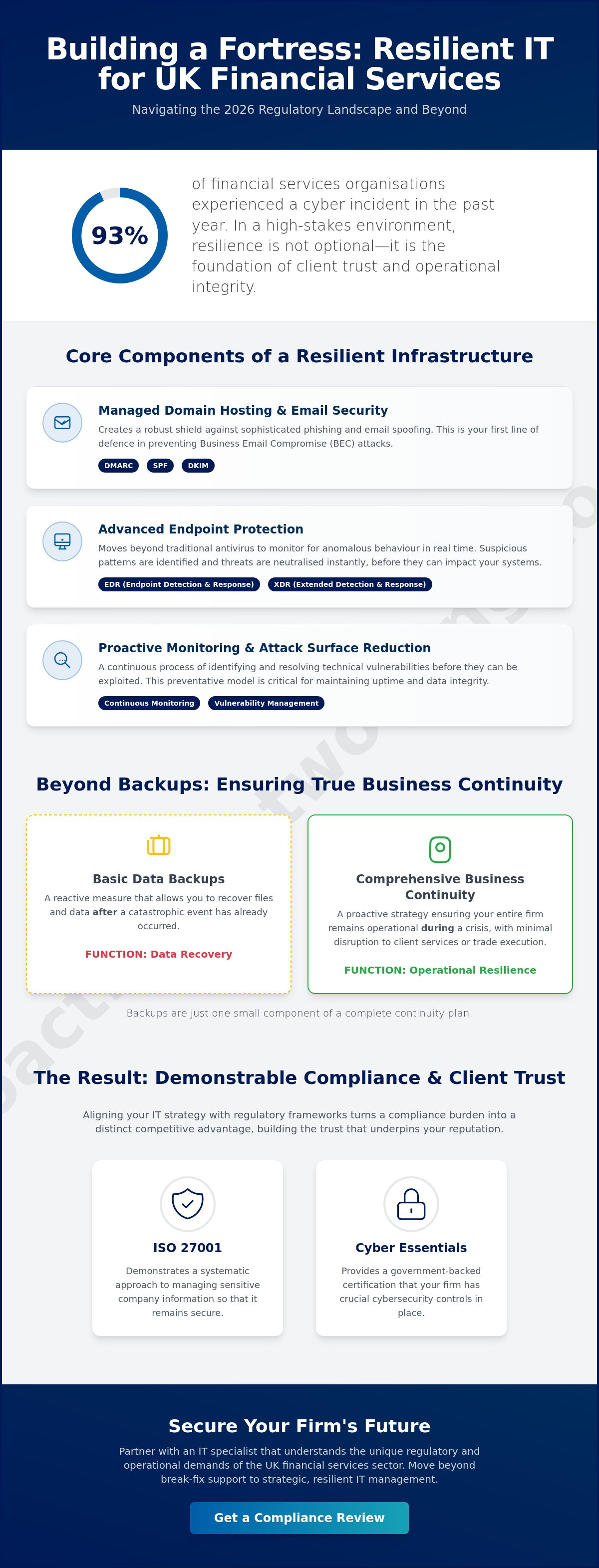
Resilient infrastructure is not a single product but a deliberate architecture of interconnected defences. Effective it support for financial services integrates security into every layer of the operational stack, ensuring that protection is both comprehensive and invisible to the end user. This approach begins with managed domain hosting, where protocols such as DMARC, SPF and DKIM verify every email sent from your firm. These standards are vital for preventing brand spoofing, a tactic often used in Business Email Compromise (BEC) attacks which cost UK businesses millions annually.
Beyond the perimeter, advanced endpoint protection has become the industry standard. Modern firms use Endpoint Detection and Response (EDR) and Extended Detection and Response (XDR) to monitor for anomalous behaviour in real time. Rather than waiting for a known virus signature, these systems identify suspicious patterns, such as a sudden attempt to encrypt files, and neutralise the threat instantly. This proactive stance aligns with the NIST Cybersecurity Framework, providing a structured methodology for identifying, protecting and recovering from digital risks.
Cyber Security: Beyond the Standard Firewall
A traditional firewall is no longer sufficient to protect sensitive financial assets. You must implement attack surface reduction to close the gaps that phishing campaigns exploit. This involves hardening your systems by disabling unused features and enforcing strict sign-in protection through conditional access. By ensuring that only authorised users on compliant devices can access your data, you create a formidable barrier against intrusion. Adopting a multi-layered cyber security strategy ensures that if one defence is breached, several others remain to protect the core of your operations. If you're concerned about your current defensive posture, a professional IT maintenance and monitoring review can identify and rectify hidden vulnerabilities before they're exploited.
Unified Communications for Financial Professionals
The rise of hybrid work has made traditional desk phones obsolete for many boutique firms. Integrating Microsoft Teams as your primary phone system allows advisors to maintain a professional presence from any location whilst keeping all communications within a secure, managed environment. This Microsoft Teams phone system integration ensures that client confidentiality is maintained through encrypted channels. It allows firms to implement call recording and logging that meet regulatory requirements for transparency and record keeping. This unified approach simplifies your technical landscape, reducing the overhead of managing separate telephony providers whilst enhancing your firm's operational resilience.
Ensuring Business Continuity and Data Resilience
True business continuity is far more than just having a copy of your data stored elsewhere. Whilst local and cloud data backups are essential components, they represent only the first step in a broader strategy. In the event of a critical failure, your firm must be able to resume operations with minimal disruption to client service or trade execution. This alignment with FCA operational resilience requirements is a necessity for maintaining your licence to operate. Comprehensive it support for financial services ensures that your recovery time objectives (RTOs) are not just theoretical figures but tested realities that can be demonstrated during an audit.
Downtime is preventable. We focus on creating a redundant environment where single points of failure are eliminated. This is particularly vital for boutique firms where the loss of a single server or internet connection could halt all activity. By distributing data across multiple secure locations, you ensure that information remains accessible even if your primary office is compromised. This structured approach provides a sense of security, allowing you to focus on your clients whilst we manage the technical complexities of your data integrity.
Failover Solutions for Uninterrupted Operations
Market access depends entirely on reliable connectivity. A single fibre break in the street shouldn't halt your business. Implementing failover internet solutions for business provides an automated switch to a secondary broadband line or 5G connection if your primary link fails. This redundancy ensures that advisors and traders remain connected to essential platforms without manual intervention. We recommend testing these recovery objectives regularly to ensure that restoration targets, such as a 4-hour return to full capacity, are consistently achievable.
Infrastructure Management for Growing Firms
Managing the lifecycle of financial software and legacy systems requires a methodical approach to hardware health. Proactive monitoring identifies hardware failure before it impacts the bottom line, allowing for scheduled replacements rather than emergency repairs. Effective it support for financial services also involves the steady maintenance of your servers and network hardware, ensuring they remain capable of supporting the high-demand applications typical of the finance sector. When firms undergo structural changes, managing complex company data mergers and separations becomes a high-risk technical challenge. We provide the strategic oversight needed to move sensitive client records between environments whilst maintaining data integrity and regulatory compliance.
Security Standards and Regulatory Compliance Frameworks
Adopting formal security standards is no longer optional for UK financial firms. It's a fundamental requirement for maintaining operational integrity and satisfying the expectations of both regulators and clients. For many organisations, the journey begins with Cyber Essentials or Cyber Essentials Plus. These government-backed schemes provide a clear framework for protecting against common digital threats. Whilst the basic certification is a self-assessment, the Plus version involves an independent technical audit. This provides a higher level of assurance to your partners. Specialist it support for financial services ensures that these standards aren't just met during the application process but are maintained through consistent monitoring and policy enforcement.
Regular security audits and vulnerability assessments are the cornerstones of a proactive defence. These evaluations identify potential weaknesses in your network before they're exploited by malicious actors. By conducting these reviews on a scheduled basis, you demonstrate a commitment to security that satisfies sophisticated investors and auditors alike. This methodical approach transforms security from a reactive cost into a demonstrable business asset. It allows your leadership team to operate with a sense of relief, knowing that the firm's digital perimeter is being actively guarded by experts.
ISO 27001: A Strategic Asset for Finance
Achieving ISO 27001 certification represents a significant milestone for any financial organisation. This international standard for information security management systems (ISMS) provides a structured way to manage sensitive company information so that it remains secure. It encompasses people, processes and IT systems. For investment boutiques and wealth managers, this accreditation builds immense confidence amongst high-net-worth clients. Your IT partner plays a critical role in this process, acting as the guardian of your ISMS and ensuring that all technical controls remain effective. This level of security accreditation provides a tangible competitive advantage, positioning your firm as a mature and reliable participant in the global market.
Specialist IT Support for Niche Sectors
Accountants, tax advisors and investment firms often have bespoke requirements that generalist providers struggle to address. These niche sectors require a deep understanding of industry-specific software and the stringent data handling rules that govern their practice. There are strong parallels between these needs and the it support for solicitors required in the legal field, where confidentiality and data integrity are equally paramount. Whether you're managing complex tax filings or navigating corporate splits and data separations, your infrastructure must support these transitions without compromising security. If you're ready to align your firm with these elite security standards, you can book a comprehensive security and compliance audit to begin your certification journey.
Partnering with Proactive Networking Ltd for Financial IT Excellence
Selecting the right partner for it support for financial services is a decision that dictates your firm's long-term stability and regulatory posture. With over 25 years of experience in the UK market, Proactive Networking Ltd has developed a deep understanding of the unique pressures faced by regulated organisations. We don't wait for systems to fail; we operate as a protective guardian, identifying potential issues before they can disrupt your operations. This commitment to proactive management ensures that your infrastructure remains a silent, reliable engine for growth rather than a source of constant concern. Our longevity in the industry means we've seen the technical landscape evolve from simple local servers to the complex, cloud-integrated environments required in 2026.
Our expertise extends to tailoring Microsoft 365 licensing and cloud optimisation specifically for the financial sector. We ensure your cloud environment is not only cost-effective but also hardened against the sophisticated threats discussed earlier. By aligning your digital tools with your business objectives, we help you achieve a level of operational excellence that satisfies both your clients and your compliance officers. This methodical approach reflects our belief that technology should empower your advisors, not hinder them. We take the time to organise your licensing structure so you only pay for the features your team actually needs, reducing unnecessary operational overhead whilst maintaining the high-tier security standards expected by the FCA.
The Proactive Advantage for SMEs
Smaller boutique firms often find themselves underserved by large, impersonal IT providers who prioritise enterprise-scale contracts. Our heritage in providing managed IT support for small business UK allows us to offer a personalised service that larger competitors cannot match. You gain direct access to senior consultants who understand the nuances of investment management and tax consultancy. This strategic partnership ensures your IT roadmap is perfectly aligned with your firm's growth trajectory, providing the sophisticated standards you expect from a premium partner. We pride ourselves on being accessible and dependable, moving away from the faceless helpdesk model to provide genuine, high-level expertise.
Next Steps: Securing Your Financial Future
Transitioning to a more secure and resilient infrastructure begins with a clear understanding of your current posture. We recommend starting with a comprehensive IT and security audit to identify any gaps in your compliance or technical defences. Our team then manages the transition process with methodical precision, ensuring minimal disruption whilst we implement your new security protocols and failover systems. Contacting our team for a sector-specific consultancy session is the first step towards a future where your technology just works. You'll be able to focus entirely on delivering value to your clients whilst we maintain the integrity of your digital landscape. This measured pace ensures that your staff feel supported and informed throughout every stage of the technical upgrade.
Securing Your Firm's Digital Legacy
The intersection of regulatory compliance and technological resilience defines the modern financial landscape. You've explored how multi-layered security, robust failover solutions and adherence to standards like ISO 27001 create a foundation for sustainable growth. Implementing strategic it support for financial services ensures that your firm remains audit-ready whilst maintaining the operational uptime required to serve your clients effectively. This structured approach transforms IT from a potential liability into a core strategic asset.
Proactive Networking Ltd brings over 25 years of industry experience to every partnership. As specialists in ISO 27001 and Cyber Essentials, we provide the bespoke support that regulated UK SMEs require to thrive amongst increasing scrutiny. We act as a steady leader in a complex technical world, allowing you to focus on your core financial objectives with absolute confidence. Secure your financial infrastructure with Proactive Networking Ltd today to establish a resilient and compliant digital environment. With the right expertise by your side, the technical challenges of the coming years become clear opportunities to demonstrate your firm's excellence and stability.
Frequently Asked Questions
What are the main IT risks currently facing UK financial services firms?
Phishing, ransomware, and supply chain vulnerabilities are the primary threats. Phishing remains the most prevalent entry point for attackers looking to compromise sensitive financial records. Supply chain attacks have become increasingly sophisticated, targeting third party software providers to gain access to broader networks. These risks necessitate a multi layered defence strategy that combines technical controls with continuous user education to mitigate human error and protect your operational integrity.
How does ISO 27001 certification benefit a small financial business?
ISO 27001 provides a globally recognised framework that proves your firm manages data with the highest level of security. For smaller firms, this certification acts as a powerful differentiator during the due diligence process for new contracts or investor reviews. It organises your security processes into a manageable system, ensuring that information remains confidential and integral whilst reducing the likelihood of a data breach and its associated reputational damage.
Can Microsoft Teams truly be used as a compliant phone system for finance?
Microsoft Teams can be used as a fully compliant phone system when integrated with suitable recording and logging tools. It allows advisors to make and receive calls whilst ensuring all interactions are captured according to FCA record keeping requirements. By using Teams as your primary telephony, you consolidate your communication channels into a single, secure environment that supports hybrid working without compromising on your firm's strict confidentiality standards.
What is the difference between EDR and XDR in a financial context?
EDR focuses on detecting threats on individual devices like laptops, whilst XDR provides a broader view across your entire network and cloud environment. In a financial context, XDR is superior because it correlates data from emails, servers, and cloud apps to identify complex attack patterns that EDR might miss. This expanded visibility is essential for it support for financial services providers who must protect sensitive data across multiple platforms simultaneously.
How often should a financial firm conduct a cyber security audit?
Financial firms should conduct a comprehensive cyber security audit at least once a year or whenever significant changes are made to the infrastructure. Regular assessments ensure that your defences remain effective against new threats and that you continue to meet regulatory obligations. More frequent vulnerability scanning, perhaps quarterly, provides an additional layer of protection by identifying technical weaknesses in your network before they can be exploited by malicious actors.
What happens to our data during a business merger or separation?
During a merger or separation, your data is systematically audited, cleansed, and migrated to a new, secure environment. We ensure that data integrity is maintained throughout the process and that no sensitive records are lost or improperly exposed. This methodical approach includes managing user permissions and ensuring that the final infrastructure remains fully compliant with GDPR and sector specific regulations to prevent any legal or operational disruptions.
Why is Cyber Essentials often a requirement for financial contracts?
Cyber Essentials is often a mandatory requirement because it demonstrates that a firm has implemented basic technical controls against the most common digital threats. Many larger financial institutions and government agencies won't partner with firms that lack this certification. It provides a baseline of security that reduces risk for everyone in the supply chain, ensuring that your firm is not the weak link in a larger financial network.
How does proactive monitoring reduce the cost of IT support over time?
Proactive monitoring reduces costs by identifying and resolving hardware or software issues before they cause expensive downtime or data loss. By maintaining your systems in peak condition, you avoid the high fees associated with emergency repairs and the lost revenue from disrupted trade execution. This model of it support for financial services shifts the focus from reactive firefighting to a steady, predictable maintenance schedule that lowers the total cost of ownership over time.


Comments