


Cyber Essentials vs ISO 27001: Which Security Standard Suits Your SME?
- Simon Raine
- May 27
- 12 min read
82% of UK businesses experienced a cyber incident in the last 12 months, according to Qualys. This sobering reality often forces a difficult decision regarding cyber essentials vs iso 27001. Selecting a framework that does not align with your specific risk profile can lead to exhausted budgets and failed audits, particularly as supply chain requirements become more rigorous and demanding.
You likely feel the pressure to demonstrate compliance whilst navigating a sea of complex technical requirements. It is a challenge to balance the need for security with the practicalities of running an SME. This article promises to demystify these standards, showing you exactly how each one functions as either a technical shield or a strategic engine for your growth.
We will explore a clear roadmap for certification and provide a cost benefit analysis to ensure your investment is sound. You will also discover which accreditation carries more weight in competitive tendering, allowing you to make a confident and informed choice for the future of your organisation.
Key Takeaways
Understand the fundamental distinction between a UK government technical baseline and a comprehensive international management framework.
Evaluate the structural differences in a cyber essentials vs iso 27001 comparison to determine if your business requires a technical shield or a strategic governance engine.
Gain clarity on the investment required for each standard, including realistic timelines and the depth of commitment needed from your leadership.
Identify which accreditation is mandatory for government tenders and which is preferred by regulatory bodies in the legal and financial sectors.
Learn why a phased implementation strategy allows you to build a secure foundation whilst mapping controls to prevent redundant effort.
Table of Contents
Understanding the Landscape: Cyber Essentials and ISO 27001 Explained
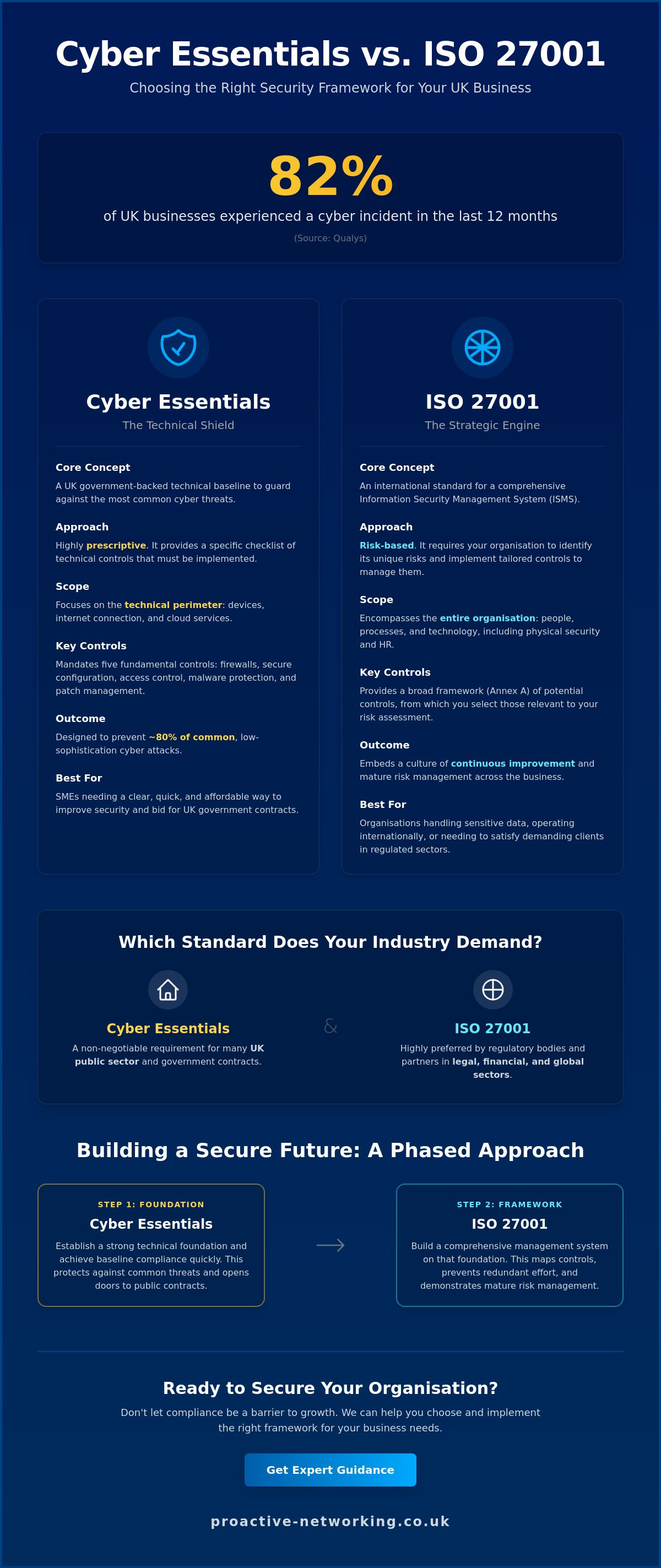
Choosing the right security framework is a pivotal decision for any growing business. The debate regarding cyber essentials vs iso 27001 often stems from a need to satisfy external stakeholders whilst maintaining internal efficiency. In the UK, supply chain requirements have become increasingly stringent. Large contractors and government bodies now expect their partners to demonstrate a verifiable commitment to data protection. These two standards offer different paths to that goal, acting as either a technical shield or a comprehensive management system.
What is Cyber Essentials?
The Cyber Essentials scheme is a UK government backed initiative designed to provide a clear, baseline level of protection. Its primary objective is to stop approximately 80% of common commodity cyber attacks that target vulnerabilities in a business digital perimeter. The standard focuses on five fundamental technical controls: firewalls, secure configuration, user access control, malware protection, and security update management. With the April 2026 Danzell update (version 3.3), there is now an even greater emphasis on multi factor authentication and cloud security.
Businesses can choose between two levels of certification. The basic version involves a self assessment questionnaire, whilst Cyber Essentials Plus requires an independent technical audit to verify that the controls are actually in place and functioning correctly. This makes it a non negotiable requirement for many public sector contracts.
What is ISO 27001?
Whilst Cyber Essentials focuses on the technical 'how', ISO 27001 addresses the strategic 'why'. It is an internationally recognised standard for an Information Security Management System (ISMS). The current version, ISO/IEC 27001:2022, provides a framework that encompasses people, processes, and technology. It doesn't just mandate specific settings; it requires a business to identify its unique risks and implement tailored controls to mitigate them.
This standard operates on a cycle of continuous improvement known as Plan Do Check Act. This ensures that security isn't just a one off box ticking exercise but a living part of the company culture. Achieving this accreditation signals to high value global partners that your organisation maintains a sophisticated, mature approach to risk management. It provides a level of reassurance that goes far beyond the technical perimeter, covering areas such as human resources, physical security, and legal compliance.
Technical Rigour vs Strategic Governance: The Structural Differences
The structural divide between cyber essentials vs iso 27001 is best understood as the difference between a technical checklist and a management philosophy. Whilst both aim to reduce risk, they operate at different depths within your organisation. Cyber Essentials acts as a rigid technical baseline. It focuses almost exclusively on the technical perimeter of your business. In contrast, ISO 27001 provides a comprehensive governance framework that integrates security into every facet of your corporate infrastructure, from HR policies to physical access at your office.
Prescriptive vs Risk-Based Approaches
Cyber Essentials is highly prescriptive. It provides a specific set of technical requirements that your devices and software must meet. This "do this, not that" approach is outlined on the official government page, ensuring that even smaller firms have a clear path to basic protection. It is an ideal solution for SMEs that need to secure their systems quickly without the burden of complex decision making.
ISO 27001 takes the opposite path. It is a risk based standard. It doesn't tell you exactly which firewall to use; instead, it requires you to identify your specific business risks and select appropriate controls to mitigate them. This flexibility is invaluable for tech focused SMEs with complex data flows, though it requires a much higher level of strategic oversight. Ensuring your technical controls align with these standards is significantly more manageable with professional IT Maintenance and Support to handle the heavy lifting.
The Human Element and Operational Impact
A significant distinction lies in the scope of protection. Cyber Essentials is concerned with hardware and software configuration. It ensures your patches are up to date and your passwords are strong. However, it rarely touches upon the behaviour of the people using those systems. ISO 27001 fills this gap by incorporating the human element into your security posture. It mandates formal procedures for onboarding and offboarding staff, supplier management, and even how visitors are handled at your premises.
This standard demands a shift in company culture. It requires leadership to take an active role in security governance rather than delegating it entirely to the IT department. Documentation is also far more intensive. Whilst Cyber Essentials may only require a verified questionnaire, ISO 27001 necessitates a detailed suite of policies and evidence of continuous monitoring. This creates a resilient environment where security is a shared responsibility amongst all employees, providing a level of protection that technology alone cannot achieve.
Comparing the Costs, Commitment and Certification Journey
Understanding the financial and operational investment required for each standard is vital for strategic planning. In the evaluation of cyber essentials vs iso 27001, the most immediate impact on your operations is the investment of time and capital. Cyber Essentials is designed for speed and technical efficiency, often achieved within weeks. ISO 27001 is a much larger undertaking, typically requiring six to twelve months of intensive preparation and cultural adjustment before the final audit occurs.
When weighing the key differences and benefits, businesses often find that Cyber Essentials is a sprint whilst ISO 27001 is a marathon. The former requires an annual renewal to stay current with evolving threats, such as those addressed in the April 2026 Danzell update. ISO 27001 operates on a three year cycle, but it necessitates annual surveillance audits to ensure the management system remains effective. Beyond the direct accreditation fees, you must account for indirect costs such as staff training, potential hardware upgrades, and the internal hours dedicated to documentation.
The Certification Process: Step-by-Step
The journey toward Cyber Essentials begins with a self assessment through an IASME portal. For many SMEs, this process is more demanding than it first appears, as it requires precise technical evidence of controls like multi factor authentication and patch management. Cyber Essentials Plus adds a layer of rigour, involving a remote or on site technical audit to verify your claims. In contrast, ISO 27001 involves a two stage audit process conducted by a UKAS accredited body. Stage one reviews your documentation and readiness, whilst stage two tests the actual effectiveness of your Information Security Management System in practice.
Resource Requirements for UK SMEs
Resource allocation is where many SMEs struggle. Research indicates that 47% of businesses with fewer than 50 employees currently have no dedicated cybersecurity budget, making efficiency paramount. ISO 27001 almost always requires a dedicated project lead or a specialised consultant to manage the vast policy suite and risk registers. This is a significant draw on internal "man-hours" that can distract from core business activities. Utilising managed IT support for small business UK can simplify this journey by automating evidence gathering and ensuring your technical infrastructure meets the required standards from the outset. This proactive involvement allows your leadership team to focus on strategic growth whilst the technical foundations are secured by experts.
Sector Specific Requirements: Which Standard Does Your Industry Demand?
The decision between cyber essentials vs iso 27001 often rests on the specific regulatory expectations of your industry. For those pursuing public sector contracts, the choice is usually made for you. The UK government mandates Cyber Essentials for any supplier handling sensitive personal information or providing certain ICT products and services. It is a non negotiable prerequisite for most tenders and represents the minimum standard for entry into the government supply chain.
In the education sector, the Department for Education (DfE) sets clear expectations for cyber security. Schools and colleges must protect vast amounts of student data and maintain operational continuity. Whilst Cyber Essentials provides the technical baseline required by many educational grants, larger institutions often look towards ISO 27001 to manage the complex data flows inherent in modern learning environments. This ensures that student records and research data remain secure against increasingly sophisticated threats.
Legal and Finance: The Gold Standard
Solicitors and barristers face unique pressures from corporate clients who demand a mature security posture. ISO 27001 has become the preferred standard for firms handling high value litigation or sensitive financial transactions. It provides the strategic assurance that the Solicitors Regulation Authority (SRA) and the Bar Council expect from modern practices. Demonstrating this level of governance is often essential for securing professional indemnity insurance on favourable terms, as it proves a proactive approach to risk management.
Financial services firms also lean toward ISO 27001 to satisfy high level regulatory due diligence. In an industry where trust is the primary currency, an internationally recognised management system provides a level of reassurance that a purely technical audit cannot match. It signals to partners and regulators that your organisation has mastered the complexities of data protection and is prepared for any eventuality.
Supply Chain Pressures and Competitive Advantage
Accreditation acts as a licence to play in larger procurement rounds. For most UK corporate supply chains, Cyber Essentials is the bare minimum requirement. However, ISO 27001 offers a significant competitive edge. It simplifies the procurement process by reducing the need to answer exhaustive security questionnaires from potential clients. Instead of manually verifying every control, you present a single, trusted certificate. If you are looking to secure your position in a competitive market, our expertise in Sector specific compliance can help you align your operations with these industry mandates.
This strategic advantage allows your business to move faster and close deals with larger organisations that prioritise security. By choosing the standard that reflects your clients' expectations, you transform security from a cost centre into a powerful business enabler. Whether you need a technical shield or a strategic engine, aligning with industry standards is the most effective way to protect your reputation and your future growth.
Building a Secure Future: Why a Phased Approach Often Works Best
The debate regarding cyber essentials vs iso 27001 is rarely a binary choice. For the majority of UK SMEs, these standards represent complementary stages of a mature security evolution. Starting with Cyber Essentials is the most logical first step. It allows you to secure your technical perimeter quickly, addressing the most common vulnerabilities whilst establishing a baseline that your clients and insurers already expect. This phased approach reduces the initial operational burden on your team and provides an immediate licence to trade in the UK market.
Efficiency is gained by mapping the five technical controls of Cyber Essentials directly to the controls found in ISO 27001 Annex A. For instance, the access controls and patch management required for CE form a significant portion of the technical evidence needed for a full Information Security Management System. By aligning these efforts early, you avoid double work and create a more efficient path toward international accreditation. This strategic alignment ensures that your technical foundations are not just compliant but also scalable as your business grows.
The Roadmap from CE to ISO 27001
Transitioning from a technical baseline to a comprehensive management system requires a clear, structured strategy. Your first task is to identify the gaps between your current technical configurations and the broader policy requirements of ISO 27001. Your existing Cyber Essentials certification serves as vital evidence during Stage 1 audits, proving to the auditor that your technical controls are already functional. We typically recommend setting a realistic 12 to 18 month milestone for this evolution. This timeframe allows your organisation to absorb the necessary cultural changes and documentation requirements without disrupting your core business activities.
Beyond the Badge: Maintaining Real Security
Obtaining a certificate is a significant achievement, but it's only the beginning of your security journey. Real resilience comes from a multi layered strategy that goes beyond a single audit date. It requires a commitment to proactive monitoring and constant attack surface reduction. Implementing advanced security measures such as EDR (Endpoint Detection and Response) and XDR (Extended Detection and Response) ensures that your organisation can identify and neutralise sophisticated threats before they cause operational damage.
Proactive Networking Ltd acts as a dedicated guardian for your operations, managing the technical burden of compliance so your leadership team can focus on growth. We ensure your systems remain audit ready year round through continuous IT maintenance and strategic monitoring. Our team specialises in maintaining the high tier standards required for the legal, barrister, and finance sectors, ensuring your protection remains robust against evolving AI driven attacks. If you are ready to secure your business and satisfy your most demanding clients, contact Proactive Networking for a compliance audit today.
Securing Your Competitive Edge
The choice regarding cyber essentials vs iso 27001 is a strategic decision that defines your organisation's resilience. Trust is paramount. A phased approach allows you to build a technical baseline whilst preparing for the strategic governance of an international standard. For SMEs in legal and financial services, these accreditations are essential for maintaining client trust and satisfying complex regulatory bodies.
Proactive Networking Ltd brings over 25 years of SME IT experience to your project. We're specialists in legal and finance sector compliance. Our managed solutions include comprehensive EDR and XDR protection, providing the technical depth needed to stay audit ready year round.
Secure your business with our expert compliance consultancy and transform your security into a business enabler. With a steady partner by your side, you'll face technical challenges with strategic foresight and total peace of mind.
Frequently Asked Questions
Is Cyber Essentials equivalent to ISO 27001 for UK government contracts?
No, Cyber Essentials is often a mandatory requirement for UK government contracts, even if you already hold ISO 27001. Whilst ISO 27001 is a broader management standard, it doesn't always satisfy the specific technical control requirements mandated by government procurement guidelines. You should check the specific tender documents, as holding both often provides the strongest competitive advantage in the cyber essentials vs iso 27001 comparison.
Can a small business with under 10 employees achieve ISO 27001?
Yes, micro organisations with fewer than 10 employees can achieve ISO 27001 certification. The standard is designed to be scalable, meaning the complexity of your Information Security Management System (ISMS) should reflect the size and risk profile of your business. Whilst the documentation burden is significant for a small team, it establishes a mature operational foundation that supports rapid, secure scaling as your organisation grows.
How much does it cost to get Cyber Essentials Plus in 2026?
The cost for Cyber Essentials Plus is not fixed and is provided on a bespoke basis by your chosen certification body. In 2026, pricing is determined by the size and complexity of your organisation's network infrastructure. You should check with an accredited provider to obtain a quote tailored to your specific number of employees and technical sites, as an independent assessor must verify your technical controls in practice.
Does ISO 27001 cover GDPR compliance requirements?
ISO 27001 provides a robust framework that aligns closely with GDPR requirements, but it doesn't automatically guarantee legal compliance. The standard's focus on data confidentiality, integrity, and availability creates a structured environment for managing personal data. By implementing an ISMS, you establish the necessary policies and technical controls to demonstrate accountability under UK data protection laws, providing a strong foundation for your broader compliance strategy.
How long does the ISO 27001 certification process take for an SME?
Most SMEs should expect the ISO 27001 certification journey to take between six and twelve months. This timeline accounts for the initial gap analysis, policy development, and the mandatory two stage audit process. The duration depends heavily on your current security maturity and the internal resources you can dedicate to the project. Professional support can often streamline this process by providing structured templates and expert guidance during the implementation phase.
What happens if my business fails a Cyber Essentials audit?
If your business fails a Cyber Essentials audit, you are typically provided with a feedback report detailing the non compliant areas. Most certification bodies offer a short grace period to rectify technical issues without requiring a full reapplication fee. Common failure points in 2026 include missing patches or inadequate multi factor authentication settings on cloud services, as mandated by the technical requirements in the April 2026 Danzell update.
Do I need to renew my Cyber Essentials certification every year?
Yes, Cyber Essentials certification must be renewed annually to remain valid. This ensures your technical controls stay aligned with the latest threat landscape and standard updates, such as the Danzell version 3.3 released in April 2026. Annual renewal is also a common requirement for maintaining cyber insurance coverage and staying eligible for government supply chain contracts, providing ongoing reassurance to your partners that your defences remain robust.
Which standard is better for reducing cyber insurance premiums?
Cyber Essentials is often the more immediate choice for reducing premiums, as many UK insurers now mandate it as a minimum requirement for coverage. However, ISO 27001 demonstrates a much higher level of risk maturity to underwriters. Holding both certifications signals that you have mastered both technical perimeters and strategic governance, which can lead to more comprehensive coverage options and potentially lower costs over the long term.


Comments